
Most british small businesses in London miss out on valuable customer connections by overlooking digital marketing channels. With more than 80 percent of UK consumers searching online before making a purchase, restaurants and aesthetics businesses need strategic online visibility to thrive. This guide breaks down essential digital channels such as SEO, social media, and email, revealing which solutions drive the most engagement and help local businesses stand out in a crowded market.
Table of Contents
- Digital Marketing Channels Defined For Small Businesses
- Key Channel Types: SEO, PPC, Social, And Email
- How Main Channels Deliver Visibility And Engagement
- Costs, Risks, And Compliance For UK Campaigns
- Maximising ROI And Avoiding Common Errors
Key Takeaways
| Point | Details |
|---|---|
| Digital Marketing Channels | Small businesses should focus on SEO, social media, PPC, email, and content marketing to engage customers effectively. |
| Strategic Alignment | Select channels that match your business goals and target audience for optimal results. |
| Compliance Management | Stay informed about data protection regulations and budget for legal consultations to mitigate risks. |
| Performance Monitoring | Continuously analyse channel performance and adjust strategies based on data to maximise ROI. |
Digital marketing channels defined for small businesses
Digital marketing channels represent strategic online pathways that London small businesses can leverage to connect with potential customers, build brand awareness, and drive growth. These channels transform how local enterprises communicate their value proposition, moving beyond traditional advertising into targeted, measurable digital interactions. Digital marketing fundamentally involves promoting products and services through web, email, and social platforms, creating opportunities for precise audience engagement.
The primary digital marketing channels small businesses should consider include search engine optimisation (SEO), social media marketing, email marketing, pay-per-click advertising, and content marketing. Each channel offers unique advantages:
- SEO: Improves website visibility in Google search results
- Social Media: Enables direct customer interaction and brand storytelling
- Email Marketing: Provides personalised communication and customer retention
- Pay-Per-Click: Delivers immediate traffic through targeted advertising
- Content Marketing: Builds authority and attracts organic audience interest
Understanding how these channels interact is crucial. UK government guidance emphasises creating fair digital market access for smaller enterprises, highlighting the importance of strategic digital channel selection. Successful implementation requires matching channels to specific business goals, target audience preferences, and available resources.
Here’s how major digital marketing channels align with common small business objectives:
| Business Objective | Best-Fit Channel(s) | Typical Outcomes |
|---|---|---|
| Build brand awareness | Social Media, SEO | Expanded regional recognition |
| Generate immediate leads | PPC, Email | Instant enquiries or sign-ups |
| Foster customer loyalty | Email, Social Media | Repeat purchases, long-term trust |
| Drive sustainable growth | SEO, Content Marketing | Consistent organic traffic growth |
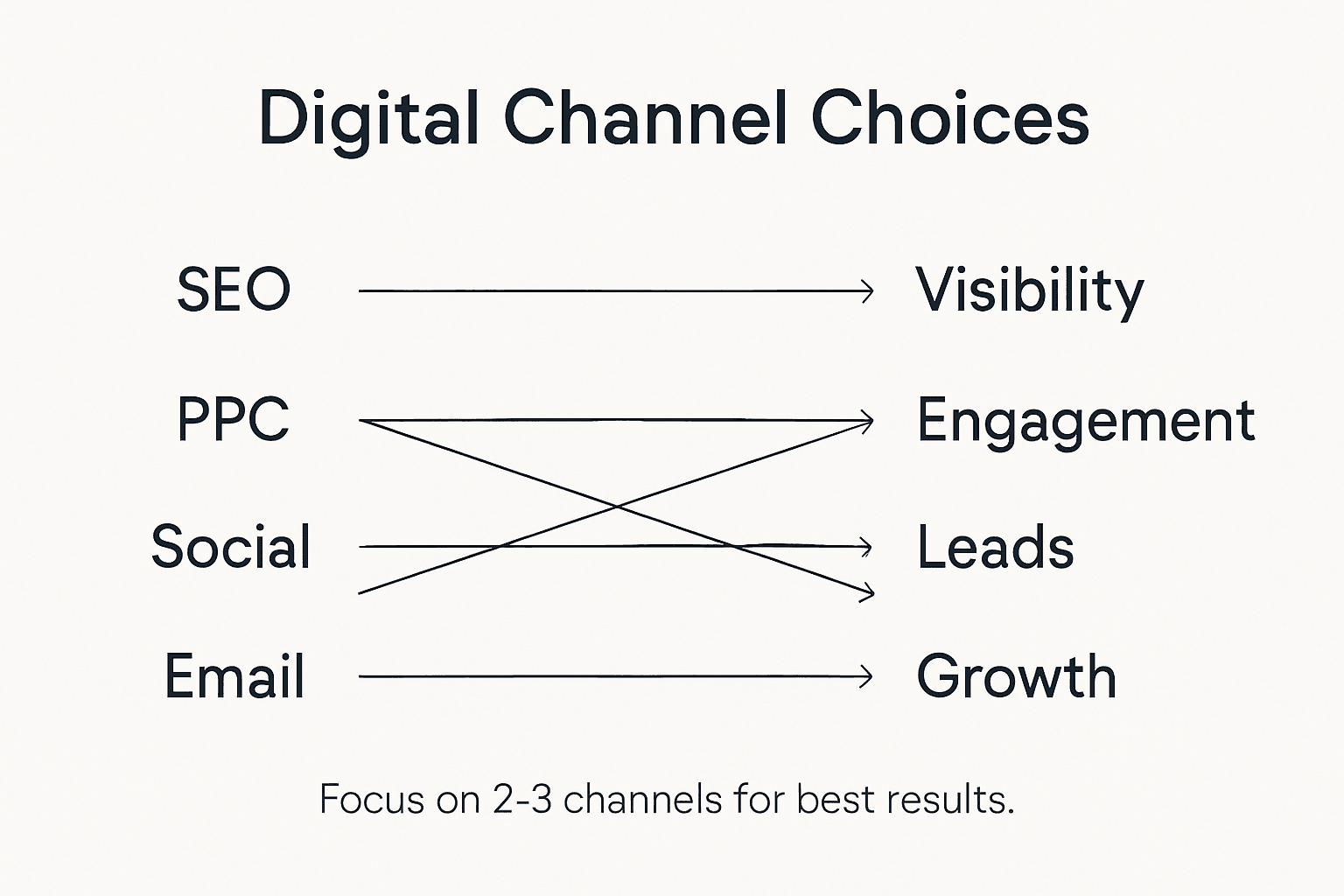
Pro Business Tip: Start small, focus on two or three digital channels that align most closely with your target market, and consistently measure performance to refine your strategy over time.
Key channel types: SEO, PPC, social, and email
Digital marketing channels represent sophisticated strategies that London small businesses can deploy to reach targeted audiences effectively. Marketing channels like SEO, PPC, social media, and email each serve unique purposes in connecting businesses with potential customers, providing nuanced approaches to digital engagement.
Here’s a detailed breakdown of these critical digital marketing channels:
- Search Engine Optimisation (SEO)
- Improves website visibility in organic search results
- Builds long-term credibility and website authority
- Cost-effective strategy for sustainable growth
- Pay-Per-Click (PPC) Advertising
- Delivers immediate website traffic
- Allows precise audience targeting
- Provides measurable and quick results
- Social Media Marketing
- Enables direct customer interaction
- Builds brand personality and community
- Supports content distribution and engagement
- Email Marketing
- Facilitates personalised communication
- Supports customer retention and loyalty
- Provides high return on investment
Effective digital marketing involves understanding how these channels complement each other, creating a comprehensive strategy that maximises reach and conversion potential. Each channel offers distinct advantages, and successful implementation requires strategic alignment with specific business objectives.
Pro Business Tip: Prioritise quality over quantity by selecting two to three channels that best match your target audience’s preferences and your business goals, rather than spreading resources too thinly across multiple platforms.
How main channels deliver visibility and engagement
Digital marketing channels are sophisticated tools that enable London small businesses to cut through the noise and connect directly with potential customers. UK SME digital adoption strategies reveal how targeted digital channels drive meaningful customer engagement and business visibility, transforming traditional marketing approaches.

Each digital marketing channel delivers visibility and engagement through unique mechanisms:
Search Engine Optimisation (SEO)
- Increases organic website visibility
- Attracts qualified traffic through relevant keyword targeting
- Builds long-term credibility and digital authority
Pay-Per-Click (PPC) Advertising
- Provides immediate visibility in search results
- Enables precise audience targeting
- Generates rapid, measurable website traffic
Social Media Marketing
- Creates interactive brand experiences
- Facilitates direct customer communication
- Supports content amplification and community building
Email Marketing
- Delivers personalised communication
- Nurtures customer relationships
- Supports targeted campaign tracking and analysis
Successful digital marketing requires understanding how these channels interconnect, creating a holistic strategy that maximises reach and engagement potential. By strategically combining these approaches, small businesses can develop a robust digital presence that attracts, converts, and retains customers more effectively than traditional marketing methods.
Pro Business Tip: Continuously monitor and analyse channel performance, focusing on metrics that directly impact your business goals rather than vanity statistics like total follower count.
Costs, risks, and compliance for UK campaigns
Digital marketing for London small businesses requires careful navigation of complex regulatory landscapes and financial considerations. The UK Digital Markets Competition Regime provides critical guidance on managing digital marketing compliance and potential risks, establishing essential frameworks for responsible campaign management.
Key Compliance Considerations:
- Data Protection Regulations (GDPR)
- Privacy and Electronic Communications Regulations (PECR)
- Age-appropriate content restrictions
- Transparent advertising practices
- Accurate performance claims
Financial Risk Management:
- Budget Control
- Set clear spending limits
- Monitor cost-per-acquisition regularly
- Use platform-specific budget management tools
- Campaign Performance Tracking
- Implement detailed analytics
- Compare actual spend against projected outcomes
- Adjust strategies based on measurable results
- Legal Compliance Costs
- Allocate budget for potential legal consultations
- Invest in compliant marketing technologies
- Consider professional indemnity insurance
Ongoing regulatory monitoring remains crucial for UK digital marketing campaigns, as legislative landscapes continuously evolve. Small businesses must remain adaptable, balancing innovative marketing approaches with strict adherence to regulatory requirements.
Below is a summary of potential compliance risks and respective mitigation strategies for UK digital marketing campaigns:
| Risk Type | Example Challenge | Recommended Mitigation |
|---|---|---|
| Data Privacy | GDPR non-compliance | Staff training and audits |
| Financial Overspend | Exceeding platform budgets | Real-time budget monitoring |
| Misleading Claims | Unsubstantiated advert promises | Legal review of all materials |
| Regulatory Change | Sudden law updates | Ongoing policy monitoring |
Pro Business Tip: Invest in regular compliance training and allocate at least 5% of your digital marketing budget towards understanding and implementing current regulatory standards to mitigate potential financial and legal risks.
Maximising ROI and avoiding common errors
Small business digital marketing strategies require sophisticated approaches to maximise return on investment, particularly for London entrepreneurs navigating increasingly competitive digital landscapes. Understanding potential pitfalls and implementing strategic measures can significantly enhance marketing effectiveness and financial outcomes.
Common Digital Marketing Errors:
- Inconsistent brand messaging
- Poorly defined target audience
- Neglecting data analytics
- Insufficient budget allocation
- Ignoring mobile user experience
ROI Maximisation Strategies:
- Precise Audience Targeting
- Develop detailed customer personas
- Use platform-specific targeting tools
- Continuously refine audience segments
- Performance Measurement
- Implement comprehensive tracking mechanisms
- Monitor key performance indicators (KPIs)
- Calculate customer acquisition costs
- Strategic Budget Management
- Start with smaller, experimental campaigns
- Allocate resources based on proven channel performance
- Use data-driven budget adjustments
Successful digital marketing demands a dynamic, adaptable approach. Small businesses must remain agile, continuously learning and optimising their strategies to maintain competitive advantage and drive sustainable growth.
Pro Business Tip: Dedicate at least 10% of your marketing budget to testing and learning, allowing room for innovation while minimising financial risks.
Unlock the True Potential of Your Digital Marketing Channels Today
Many London small businesses struggle to translate their understanding of SEO, PPC, social media, and email marketing into real growth and measurable results. The challenge lies in choosing the right channels that fit your unique goals while navigating budget control and compliance risks. If you are aiming to build brand awareness, generate leads, or foster customer loyalty with clarity and confidence Market Link Solutions is here to support you.
Our expert team specialises in helping small businesses like yours turn practical digital marketing insights into tailored campaigns. From responsive Web Design and Development that boosts SEO visibility to targeted PPC Advertising on Google and Instagram we empower your business to attract and engage local customers more effectively. Discover how other London SMEs have achieved success by reading our Success Stories Archives – Digital Marketing Agency – Market Link Solutions.

Take control of your digital marketing channels today with Market Link Solutions. Visit https://market-link.co.uk to learn more about how we can help you maximise ROI and drive sustainable growth with clear strategies and measurable results.
Frequently Asked Questions
What are the key digital marketing channels for small businesses?
The primary digital marketing channels for small businesses include search engine optimisation (SEO), social media marketing, email marketing, pay-per-click (PPC) advertising, and content marketing. Each channel serves unique purposes in connecting with potential customers.
How can SEO improve my business’s online visibility?
SEO enhances your website’s presence in organic search results, allowing you to attract qualified traffic by optimising relevant keywords. This builds long-term credibility and authority for your business online.
What is the role of content marketing in digital marketing strategies?
Content marketing is crucial as it establishes your business’s authority and attracts organic interest from potential customers. By creating valuable content, you can engage your audience, build trust, and drive sustainable growth.
How can I measure the effectiveness of my digital marketing campaigns?
You can measure the effectiveness of your digital marketing campaigns by implementing detailed analytics, tracking key performance indicators (KPIs), and comparing actual spend against projected outcomes. This allows you to adjust strategies based on measurable results.
Recommended
- What Is Digital Marketing? Complete Guide for London SMEs – Digital Marketing Agency – Market Link Solutions
- Complete Guide to Why Use Digital Marketing
- Why Invest in Digital Marketing: Complete Guide
- Website Performance Guide – Digital Marketing Agency – Market Link Solutions
- Commentions | What to do instead of buying linkedin connections (100% Smarter & Effective)