
Nearly 80 percent of British diners research London restaurants online before deciding where to eat. For restaurant owners, this digital shift means your online presence can make or break customer footfall. Whether you run a cosy neighbourhood spot or a trendsetting eatery, mastering digital marketing strategies like SEO and PPC advertising gives you a powerful edge. Discover how targeted tactics can turn browsers into loyal patrons and help your restaurant thrive in an increasingly competitive market.
Table of Contents
- Defining Digital Marketing For Restaurants
- Key Channels: SEO, PPC, And Web Design
- Common Misconceptions About Restaurant Marketing
- Enhancing Online Visibility And Customer Engagement
- Cost, Budget, And ROI Considerations
- Pitfalls To Avoid In Digital Strategies
Key Takeaways
| Point | Details |
|---|---|
| Digital Marketing Strategy | A comprehensive digital marketing strategy is essential for restaurants to engage and convert potential diners into loyal customers. |
| Key Channels | Focus on SEO, PPC, and strategic web design to enhance visibility and drive bookings. |
| Budgeting for Marketing | Allocate 5-10% of total revenue to digital marketing for effective investment and tracking of ROI. |
| Common Pitfalls | Avoid inconsistent messaging, neglecting mobile optimisation, and failing to engage with customers online to maintain a strong digital presence. |
Defining digital marketing for restaurants
Digital marketing for restaurants represents a comprehensive strategy that leverages online platforms to connect, engage, and convert potential diners into loyal customers. Digital marketing strategies within the restaurant sector fundamentally transform how dining establishments communicate and build relationships with their target audience through interactive digital channels.
These strategies encompass multiple digital touchpoints, including social media marketing, search engine optimisation, email campaigns, online advertising, and content creation. The primary goal is to create a robust digital presence that attracts customers, builds brand awareness, and ultimately drives restaurant bookings and foot traffic. Restaurants can utilise platforms like Instagram for visual menu showcasing, Facebook for community engagement, Google My Business for local search visibility, and targeted digital advertising to reach specific demographic groups interested in dining experiences.
Successful digital marketing for restaurants requires a strategic approach that integrates multiple online channels. Perspectives on digital marketing in the restaurant industry highlight the importance of managing online feedback, creating compelling visual content, and leveraging data analytics to personalise marketing efforts. This means understanding your restaurant’s unique value proposition and communicating it effectively through carefully crafted digital campaigns that resonate with your target dining audience.
Pro tip: Develop a consistent brand voice across all digital platforms and use high-quality, professionally shot food imagery to make your digital marketing more appealing and engaging.
Key channels: SEO, PPC, and web design
Digital marketing for London restaurants relies on three critical channels: search engine optimisation (SEO), pay-per-click (PPC) advertising, and strategic web design. The transformation of marketing channels in the food service industry demonstrates how these interconnected digital strategies can significantly enhance a restaurant’s online visibility and customer acquisition.
Search engine optimisation (SEO) helps restaurants improve their organic search rankings, ensuring they appear prominently when potential diners search for local dining options. This involves optimising website content with relevant keywords, creating location-specific landing pages, managing Google My Business listings, and developing high-quality, locally-focused content that attracts both search engines and potential customers. PPC advertising complements SEO by allowing restaurants to purchase targeted advertising space on search engines and social media platforms, enabling precise demographic targeting and immediate visibility for specific dining offerings or promotions.

Web design serves as the foundational element that supports both SEO and PPC efforts. A well-designed restaurant website should be mobile-responsive, visually appealing, and engineered to convert website visitors into actual diners. This means incorporating elements like easy online booking systems, clear menu presentations, high-quality food photography, customer testimonials, and streamlined navigation that provides a seamless user experience across all digital devices.
Pro tip: Integrate your website analytics with your digital marketing tools to track user behaviour, understand customer preferences, and continuously refine your online marketing strategies.
Here is a summary of how key digital marketing channels contribute to restaurant success:
| Channel | Main Purpose | Impact on Restaurants |
|---|---|---|
| SEO | Boost search visibility | Attracts local customers online |
| PPC Advertising | Achieve immediate reach | Drives rapid traffic for promotions |
| Web Design | Convert site visitors | Encourages bookings and loyalty |
| Social Media | Build and engage community | Strengthens brand and relationships |
Common misconceptions about restaurant marketing
Many London restaurant owners harbour misguided beliefs about digital marketing that can severely limit their business potential. Perspectives on digital marketing misconceptions in the restaurant industry reveal that these myths prevent many establishments from leveraging powerful online strategies that could dramatically improve their visibility and customer engagement.
One prevalent misconception is that digital marketing is exclusively beneficial for large restaurant chains with substantial budgets. In reality, small and independent restaurants can achieve remarkable results through targeted, cost-effective digital strategies. Digital strategy barriers for small restaurant businesses demonstrate that with intelligent planning, even modest marketing investments can yield significant returns. Many restaurant owners mistakenly believe that traditional word-of-mouth marketing is superior to digital channels, failing to recognise that modern diners extensively research restaurants online before making dining decisions.
Another critical misunderstanding is the perceived complexity and expense of digital marketing. Restaurants often assume that developing an effective online presence requires extensive technical knowledge or massive financial investment. However, numerous affordable and user-friendly digital tools now enable even small restaurants to create compelling online marketing campaigns. These include social media platforms, Google My Business, targeted local advertising, and content marketing strategies that can be implemented with minimal technical expertise and budget.
Pro tip: Start small by focusing on one or two digital marketing channels that best suit your restaurant’s target audience, and gradually expand your online presence as you gain confidence and experience.
Common misconceptions can hinder restaurant marketing effectiveness. Below is a comparison of prevalent myths and the actual realities:
| Misconception | Reality | Positive Outcome When Addressed |
|---|---|---|
| Only large restaurants benefit | Small ones thrive with strategy | Reach and engage local diners cost-effectively |
| Digital marketing is too complex | Accessible tools are available | Simple adoption with minimal training |
| Word-of-mouth beats online methods | Diners research online first | Greater online visibility, more bookings |
| High expense is required | Modest budgets can succeed | Maximised return on smaller investments |
Enhancing online visibility and customer engagement
Digital marketing has transformed how London restaurants connect with potential diners, creating unprecedented opportunities for visibility and meaningful customer interactions. Strategies for enhancing restaurant online engagement reveal that successful digital presence goes far beyond simple website maintenance, requiring a sophisticated, multi-channel approach that actively builds relationships with customers.
Effective online visibility starts with comprehensive digital platform management. This means developing a consistent brand presence across multiple channels, including social media platforms, review sites, and local business directories. Restaurants must craft compelling content that showcases their unique culinary offerings, atmosphere, and personality. High-quality food photography, behind-the-scenes glimpses, chef interviews, and interactive content like menu highlights or special event announcements can dramatically increase audience engagement and attract potential diners.
Customer engagement requires proactive and responsive digital communication strategies. This involves systematically monitoring and responding to online reviews, engaging with customer comments on social media, and using analytics to understand customer preferences and behaviour. Modern diners expect restaurants to be accessible, transparent, and interactive online. By creating a two-way digital dialogue, restaurants can build trust, demonstrate their commitment to customer satisfaction, and transform casual online interactions into actual dining experiences.
Pro tip: Develop a consistent response protocol for online interactions, aiming to reply to all customer feedback within 24 hours to show you value their input and experience.
Cost, budget, and ROI considerations
Understanding the financial implications of digital marketing is crucial for London restaurants seeking to maximise their return on investment. Digital marketing investment strategies for restaurant growth reveal that strategic budget allocation can transform digital marketing from an expense into a powerful revenue-generating tool.
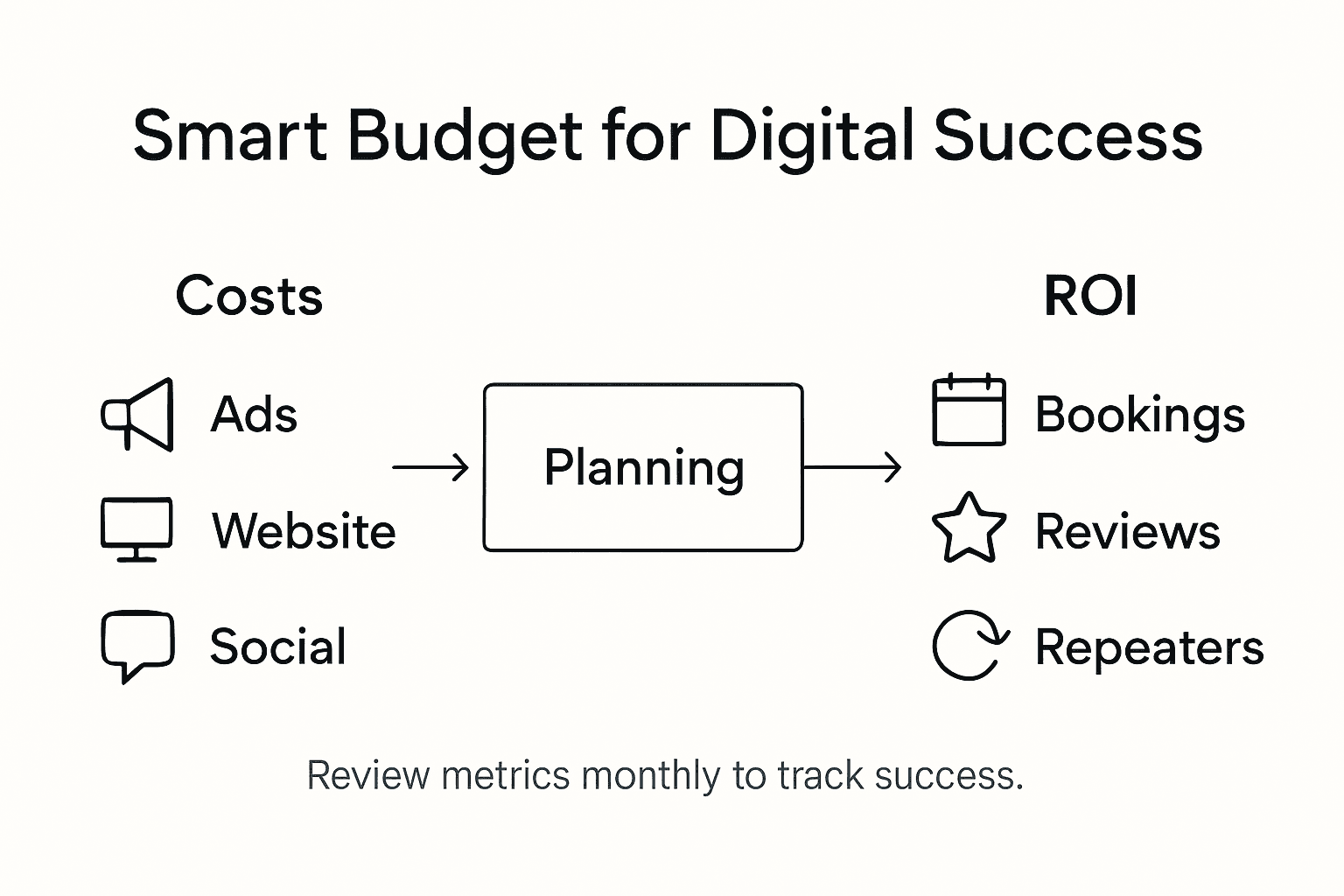
Restaurants should approach digital marketing budgeting with a nuanced perspective, recognising that cost-effectiveness does not mean minimal spending, but rather intelligent investment. Typically, small to medium-sized London restaurants might allocate between 5-10% of their total revenue to digital marketing efforts. This budget should be distributed across key channels such as social media advertising, search engine optimisation, content creation, and targeted online campaigns. Crucially, restaurants must track specific performance metrics like customer acquisition cost, conversion rates, and direct revenue generated from digital marketing activities.
The return on investment (ROI) for digital marketing extends beyond immediate financial returns. While direct bookings and increased foot traffic are tangible outcomes, restaurants also gain long-term benefits such as brand recognition, customer loyalty, and a robust online reputation. Advanced digital marketing strategies allow for precise audience targeting, enabling restaurants to reach potential customers more efficiently than traditional advertising methods. By leveraging data analytics and customer insights, restaurants can continually refine their marketing approach, ensuring that each pound spent delivers maximum value.
Pro tip: Implement a monthly review of your digital marketing performance, comparing spend against key metrics like new customer acquisitions, repeat bookings, and social media engagement to ensure continuous improvement.
Pitfalls to avoid in digital strategies
Digital marketing for London restaurants is fraught with potential missteps that can significantly undermine online success. Common digital marketing mistakes in restaurant strategies highlight critical errors that can derail even the most well-intentioned digital campaigns.
One of the most prevalent pitfalls is inconsistent messaging across digital platforms. Restaurants often make the mistake of presenting different brand voices, visual styles, or messaging on various channels like Instagram, Facebook, and their website. This fragmentation confuses potential customers and weakens brand recognition. Another significant error is neglecting mobile optimization, which is particularly crucial given that most diners now research restaurants using smartphones. A website or social media presence that doesn’t render perfectly on mobile devices can instantly turn away potential customers.
Restaurants frequently underestimate the importance of genuine, personalised online interactions. Many fall into the trap of treating digital marketing as a one-way communication channel, posting generic content without engaging with customer comments, reviews, or feedback. This approach misses the fundamental purpose of digital marketing: creating meaningful connections with potential and existing customers. Additionally, failing to monitor and actively manage online reputation can be catastrophic. Negative reviews left unaddressed, slow response times, or inappropriate responses can quickly damage a restaurant’s digital presence and deter potential diners.
Pro tip: Conduct a monthly digital audit of your online platforms, checking for consistent branding, mobile responsiveness, and timely engagement with customer interactions.
Unlock Your London Restaurant’s Full Potential with Expert Digital Marketing
Struggling to stand out in London’s competitive dining scene? Many restaurants face challenges like limited online visibility, inconsistent messaging, and the complexity of digital marketing strategies discussed in this article. At Market Link Solutions, we understand these pain points and specialise in tailoring solutions that combine SEO optimisation, PPC Advertising on Google and Instagram, and bespoke Web Design and Development to help your restaurant attract and engage more local diners effectively.
Explore our Success Stories Archives – Digital Marketing Agency – Market Link Solutions to see how we’ve transformed small London businesses just like yours. Don’t let digital marketing misconceptions hold back your restaurant’s growth. Visit Market Link Solutions today to start building a stronger online presence that converts visitors into loyal customers. Take control of your digital journey now and maximise your return on investment with our proven, cost-effective strategies.
Frequently Asked Questions
What are the main channels of digital marketing for restaurants?
Digital marketing for restaurants primarily relies on search engine optimisation (SEO), pay-per-click (PPC) advertising, and strategic web design to enhance online visibility and attract customers.
How can SEO benefit my restaurant’s online presence?
SEO helps improve your restaurant’s organic search rankings, ensuring it appears prominently when potential diners search for local dining options, ultimately attracting more customers.
What role does social media play in restaurant marketing?
Social media is essential for building and engaging with the community, allowing restaurants to showcase their offerings, interact with customers, and create brand awareness through platforms like Instagram and Facebook.
Why is it important to have a mobile-responsive website for my restaurant?
A mobile-responsive website ensures a seamless user experience for diners who research restaurants on their smartphones. It significantly affects customer engagement and the likelihood of making bookings.
Recommended
- Local SEO for London Restaurants: Boost Footfall and Visibility
- Restaurant PPC Advertising Guide for London Success – Digital Marketing Agency – Market Link Solutions
- Instagram Ads for Restaurants Workflow: Boost Bookings Fast
- What Is Digital Marketing? Complete Guide for London SMEs – Digital Marketing Agency – Market Link Solutions
- 7 Top Marketing Channels Every Ecommerce Owner Must Use