
Most advice about Google Ads leaves british small business owners confused rather than confident. Every year, over 60 percent of London companies report struggling with advertising jargon that holds back their online growth. Knowing the right terminology is more than just ticking a box—it shapes how much you spend, who sees your adverts, and which customers reach your website. This guide breaks down the key terms, making Google Ads simpler for every british entrepreneur aiming for real results.
Table of Contents
- Defining Google Ads Terminology for Small Businesses
- Essential Campaign Types and Ad Formats Explained
- Bidding Strategies and Budgeting in Google Ads
- Key Metrics and Performance Indicators to Track
- Common Pitfalls and Mistakes to Avoid
Key Takeaways
| Point | Details |
|---|---|
| Understand Key Terminology | Familiarity with terms like Keywords, Impressions, and CTR is essential for effective advertising. |
| Choose Appropriate Campaigns | Select from Search, Display, Video, Shopping, and Local Service Ads based on your business objectives. |
| Monitor Key Metrics | Track CTR, Conversion Rate, and ROAS to assess campaign performance and optimise spending. |
| Avoid Common Mistakes | Conduct regular audits of keyword targeting and ad relevance to eliminate ineffective strategies. |
Defining Google Ads Terminology for Small Businesses
Navigating the world of digital advertising requires understanding key Google Ads terminology, particularly for London’s small businesses looking to maximise their online marketing efforts. Google’s Small Business Online Marketing Guide provides essential definitions that help entrepreneurs break through digital marketing complexities.
At its core, Google Ads operates through several fundamental concepts small business owners must comprehend. Keywords represent the search terms potential customers use, determining when and where your advertisements appear. Impressions measure how frequently your ad is displayed, while Click-Through Rate (CTR) tracks the percentage of people who actually click your advertisement after seeing it. Geotargeting allows businesses to focus their advertising on specific geographical areas, which is particularly valuable for local London enterprises seeking neighbourhood-specific customer engagement.
Understanding advanced terminology can transform your digital marketing strategy. Negative Keywords prevent your ads from appearing in irrelevant searches, saving precious advertising budget. Landing Pages are the specific web pages users arrive at after clicking your advertisement, and their design critically influences conversion rates. Cost-Per-Click (CPC) represents the amount you pay each time someone clicks your advertisement, making budget management crucial for small businesses with limited marketing resources.
Pro Business Tip: Start with a modest daily budget and gradually increase spending as you learn which keywords and targeting strategies generate the most effective results for your specific business sector.
Essential Campaign Types and Ad Formats Explained
Small businesses in London need a strategic approach to Google Ads, understanding the diverse campaign types that can effectively reach potential customers. Professional certification programmes in Google Ads highlight the importance of selecting the right campaign format for specific marketing objectives.
Google Ads offers several primary campaign types tailored to different business needs. Search Campaigns appear directly in Google search results, targeting users actively seeking specific products or services. These text-based advertisements are crucial for businesses wanting immediate visibility. Display Campaigns utilise visual banner advertisements across websites, allowing businesses to build brand awareness and reach broader audiences. Video Campaigns leverage platforms like YouTube, enabling companies to create engaging visual content that captures potential customers’ attention through multimedia storytelling.
Moreover, specific ad formats can dramatically influence marketing effectiveness. Responsive Search Ads automatically adjust text to match potential customer search queries, increasing relevance and click-through rates. Shopping Ads prove particularly powerful for retail businesses, showcasing product images, prices, and merchant details directly in search results. Local Service Ads are especially beneficial for service-based London businesses, displaying contact information, ratings, and direct booking options to neighbourhood customers.
Pro Business Tip: Experiment with multiple campaign types and monitor performance metrics closely, allocating budget to formats that generate the most cost-effective conversions for your specific business model.
The following table compares popular Google Ads campaign types and their typical business outcomes:
| Campaign Type | Typical Objective | Best For |
|---|---|---|
| Search | Immediate conversions | Service firms seeking leads |
| Display | Brand visibility | Retailers expanding local awareness |
| Video | Engagement and attention | Creative brands or event promotion |
| Shopping | Product sales | E-commerce and physical retailers |
| Local Service | Direct enquiries/bookings | Tradespeople, salons, neighbourhood SMEs |
Bidding Strategies and Budgeting in Google Ads
Understanding Google Ads bidding strategies is crucial for London small businesses seeking to maximise their digital marketing investment. Google’s comprehensive documentation on bidding strategy types provides critical insights into selecting the most appropriate approach for specific campaign objectives.

Small businesses have multiple bidding strategies to choose from, each designed to achieve different marketing goals. Manual Cost-Per-Click (CPC) allows precise control, enabling businesses to set maximum bid amounts for specific keywords. Automated Bidding Strategies like Target Cost-Per-Acquisition (CPA) automatically adjust bids to secure conversions within a predetermined budget, ideal for businesses wanting predictable marketing expenses. Target Return on Ad Spend (ROAS) proves particularly effective for e-commerce enterprises, automatically optimising bids to maximise revenue relative to advertising expenditure.
Budget allocation requires strategic thinking beyond simple monetary considerations. Successful campaigns demand continuous monitoring and adjustment of bidding strategies. Maximize Clicks strategy works well for businesses prioritising website traffic, while Enhanced Cost-Per-Click (ECPC) automatically adjusts manual bids to improve conversion potential. London businesses should consider their specific objectives, whether brand awareness, lead generation, or direct sales, when selecting their optimal bidding approach.
Pro Business Tip: Start with a conservative daily budget, allocate funds across different bidding strategies, and closely track performance metrics to identify the most cost-effective approach for your specific business model.
Key Metrics and Performance Indicators to Track
Measuring the success of Google Ads campaigns requires a comprehensive understanding of critical performance metrics. Insights from digital marketing experts highlight the essential indicators that London businesses must monitor to optimise their advertising investments.
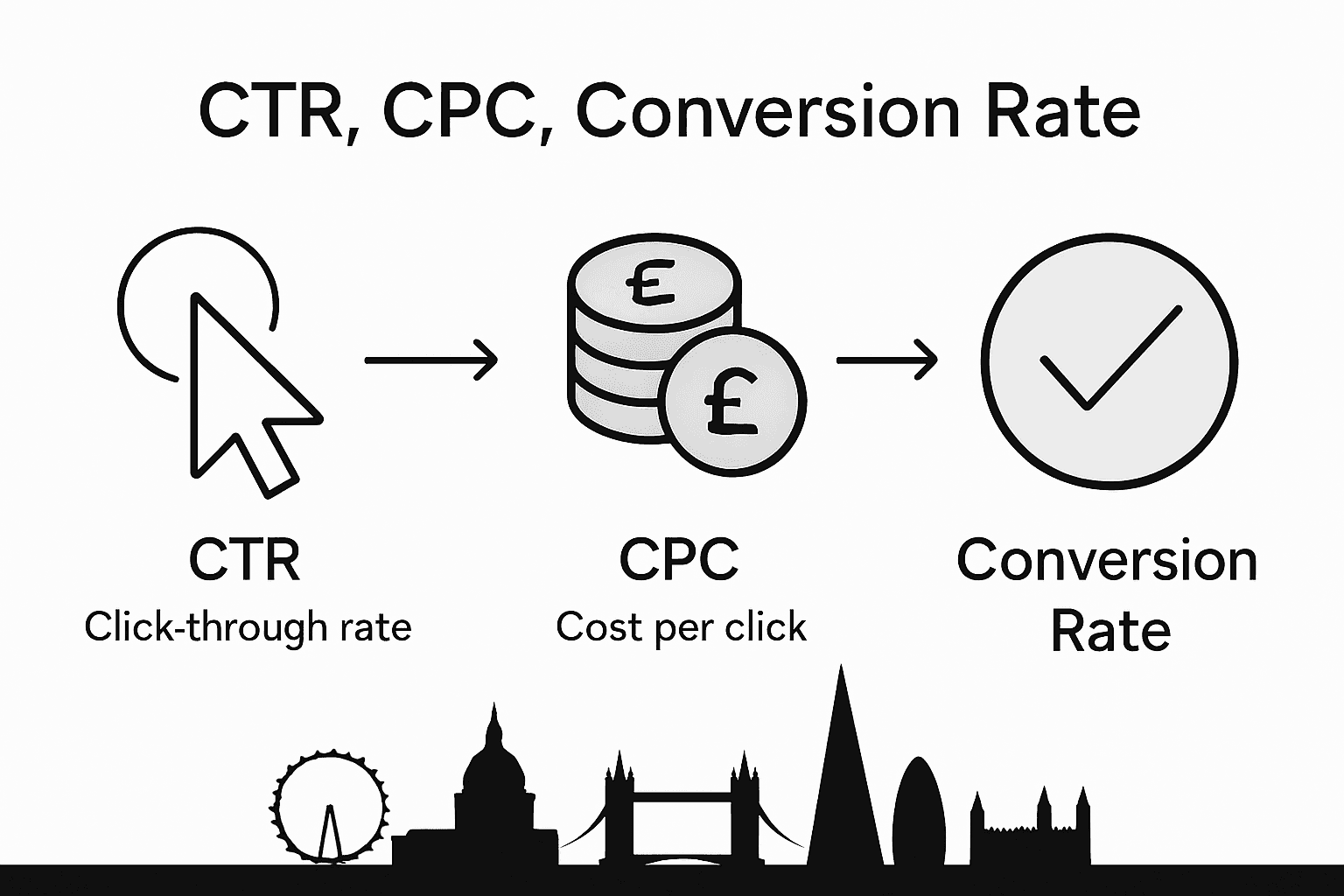
Click-Through Rate (CTR) represents the percentage of users who click your advertisement after viewing it, serving as a fundamental indicator of ad relevance and appeal. Conversion Rate measures the proportion of clicked visitors who complete a desired action, such as purchasing a product or signing up for a service. Quality Score emerges as a critical metric, evaluating the overall quality and relevance of your advertisements, keywords, and landing pages on a scale of 1 to 10 – with higher scores potentially reducing advertising costs and improving ad positioning.
Additional key performance indicators provide deeper insights into campaign effectiveness. Cost-Per-Click (CPC) helps businesses understand the financial efficiency of their advertising efforts, while Cost-Per-Acquisition (CPA) reveals the actual expense of acquiring a new customer. Return on Ad Spend (ROAS) offers a comprehensive view of revenue generated relative to advertising expenditure, enabling businesses to assess the true financial impact of their Google Ads campaigns. London small businesses should pay particular attention to these metrics, as they directly influence marketing strategy and budget allocation.
Pro Business Tip: Create a monthly dashboard tracking these key metrics, comparing performance against industry benchmarks and your own historical data to identify trends and opportunities for continuous improvement.
Here is a summary of key Google Ads metrics and what they reveal:
| Metric | What It Reveals | Why It Matters to Small Firms |
|---|---|---|
| CTR | Ad relevance to searchers | Indicates effectiveness of messaging |
| Conversion Rate | Visitor action on site | Measures return on ad spend |
| Quality Score | Keyword and ad quality | Affects ad cost and placement |
| CPC | Average cost per ad click | Helps control overall spend |
| ROAS | Return on ad spend | Gauges profit from advertising efforts |
Common Pitfalls and Mistakes to Avoid
Google Ads can be a minefield for inexperienced London businesses, with numerous potential errors that can quickly drain marketing budgets. Navigating the complexities of digital advertising requires strategic awareness and proactive management to avoid costly mistakes.
One of the most critical errors small businesses make is poorly defined keyword targeting. Broad or overly generic keywords can attract irrelevant traffic, wasting precious advertising expenditure. Businesses must develop precise, long-tail keywords that closely match their specific products or services. Another significant pitfall involves neglecting negative keywords, which prevent advertisements from appearing in unrelated search queries. For instance, a luxury hair salon should exclude terms like ‘cheap’ or ‘discount’ to attract high-value clients seeking premium services.
Budget mismanagement represents another substantial risk for London entrepreneurs. Inadequate budget allocation can result in campaigns that either exhaust funds too quickly or fail to generate meaningful engagement. Businesses often make the mistake of setting static budgets without regular performance review, overlooking the importance of dynamic adjustment based on real-time metrics. Equally problematic is creating single, generic advertisements instead of developing targeted ad variations that speak directly to specific customer segments. Each advertisement should be crafted with a clear understanding of the intended audience’s specific needs and pain points.
Pro Business Tip: Conduct a monthly audit of your Google Ads performance, reviewing keyword effectiveness, ad relevance, and conversion rates to systematically eliminate underperforming elements and optimise your advertising strategy.
Master Google Ads Terminology and Grow Your London Business Today
Understanding Google Ads terminology like Keywords, CTR and Bidding Strategies can feel overwhelming yet mastering them is crucial to boost your local presence and advertise efficiently without wasting budget. If you are a London small business struggling with complex Google Ads concepts or unsure how to optimise your campaigns for better conversions visit our Success Stories Archives – Digital Marketing Agency – Market Link Solutions to see how businesses like yours transformed their advertising results.
Ready to take control of your Google Ads campaigns with expert guidance that delivers measurable results Our London based team specialises in web design development PPC advertising on Google and Instagram as well as effective SEO optimisation. Let us help you avoid common pitfalls, optimise bids and create targeted ads tailored to your audience. Visit https://market-link.co.uk now and start building a powerful online presence that drives real growth.
Frequently Asked Questions
What are keywords in Google Ads?
Keywords are the specific search terms potential customers use when looking for products or services. They determine when and where your advertisements will appear in search results.
How does geotargeting work in Google Ads?
Geotargeting allows businesses to focus their advertising efforts on specific geographical areas, enabling local engagement by showing ads to users in particular locations.
What is the difference between Search and Display campaigns?
Search campaigns show text-based advertisements directly in Google search results, targeting users actively searching for related products or services, while Display campaigns use visual banner ads across various websites to build brand awareness.
Why is it important to monitor metrics like Click-Through Rate (CTR) and Conversion Rate?
Monitoring metrics such as CTR and Conversion Rate is crucial as they provide insights into the effectiveness of your ads. CTR indicates how relevant your ads are to search users, and Conversion Rate measures how many users complete desired actions after clicking your ads.