
Building a successful website for your London restaurant or wellness clinic means more than creating an attractive page. Many small business owners find that clear website goals and a deep understanding of their local audience are what separates an effective online presence from an ordinary one. By focusing on defining your website’s core objectives and the specific customers you want to reach, you lay the groundwork for a website that not only looks professional but supports your growth.
Table of Contents
- Step 1: Define Your Website Goals And Audience
- Step 2: Choose The Right Web Platform And Domain
- Step 3: Design A User-Focused Layout And Branding
- Step 4: Populate Content Optimised For Seo And Ads
- Step 5: Test Functionality And Launch Your Site
Quick Summary
| Key Insight | Explanation |
|---|---|
| 1. Define clear website goals | Establish specific objectives that align with your business strategy to enhance user engagement and conversion rates. |
| 2. Select user-friendly platforms | Choose accessible web platforms that cater to your technical skills and budget while ensuring flexibility and growth. |
| 3. Focus on user-friendly design | Create an intuitive and visually appealing layout to improve the overall user experience and encourage potential customer actions. |
| 4. Optimise content for SEO | Develop high-quality content that addresses customer needs, incorporates relevant keywords, and enhances your search visibility. |
| 5. Conduct thorough testing pre-launch | Ensure your website functions smoothly across all devices and platforms for a professional online presence that builds trust. |
Step 1: Define your website goals and audience
Building a successful business website starts with crystal-clear goals and a deep understanding of your target audience. Your website isn’t just a digital brochure – it’s a strategic tool designed to drive your London small business forward.
Defining your website’s purpose requires thoughtful consideration. Clarifying your core objectives involves identifying specific outcomes that align with your business strategy. These goals might include:
- Generating qualified leads for your services
- Showcasing your professional portfolio
- Building brand credibility among local London customers
- Providing essential information about your business offerings
To pinpoint your target audience effectively, develop detailed customer personas considering factors like age, profession, income level, and specific needs. For a restaurant, this might mean targeting young professionals seeking convenient lunch options; for a wellness clinic, it could be health-conscious individuals aged 35-55.
Knowing exactly who you’re targeting helps create a website that speaks directly to your ideal customers.
By mapping your audience’s preferences and matching them with your business objectives, you’ll create a website that not only looks professional but drives tangible business results.
Pro tip: Conduct brief customer surveys or analyse your existing client base to refine your audience understanding and website goals more precisely.
Step 2: Choose the right web platform and domain
Selecting the perfect web platform and domain is crucial for establishing your London small business’s online presence. Your website’s foundation will determine its functionality, professional appearance, and ability to attract potential customers.
When choosing a web platform, consider your technical skills, budget, and specific business requirements. For most London SMEs, user-friendly platforms like WordPress or Wix offer excellent website builder solutions that balance simplicity and customisation. Key considerations include:
- Ease of use for non-technical business owners
- Customisation options matching your brand identity
- Mobile responsiveness for seamless viewing
- Integration capabilities with marketing tools
- Pricing structure that fits your budget
For your domain name, choose a UK-specific extension like .co.uk or .uk to enhance local search visibility. Your domain should be:
- Memorable and concise
- Closely aligned with your business name
- Easy to spell and pronounce
- Avoiding potential trademark conflicts
Your domain name is your digital address – make it count.
Consider purchasing your domain from reputable UK providers that offer competitive pricing and reliable customer support. Some providers also bundle domain registration with website hosting, potentially reducing overall costs.
Here is a summary of key considerations when selecting a web platform for small London businesses:
| Consideration | Importance for London SMEs | Potential Pitfalls |
|---|---|---|
| Technical Skills | Favour platforms needing minimal expertise | Choosing complex systems increases support costs |
| Customisation | Allows better brand alignment | Over-customisation may hinder updates |
| Integration | Supports marketing and analytics | Poor integration limits business growth |
| Pricing | Crucial for SMEs with tighter budgets | Unexpected fees can strain resources |
Pro tip: Check domain availability early and consider purchasing similar variations to protect your brand’s online identity.
Step 3: Design a user-focused layout and branding
Creating a compelling website design is about more than just looking attractive – it’s about crafting an intuitive, engaging experience that converts visitors into customers. Your website’s visual identity and navigation are critical for making a powerful first impression on potential clients.
User-friendly website design requires strategic thinking about your audience’s needs and your business goals. Consider these essential design principles:
- Consistent colour palette reflecting your brand identity
- Clear, readable typography
- Intuitive navigation menu
- High-quality, relevant imagery
- Strategic placement of call-to-action buttons
Your branding should communicate professionalism and trustworthiness. This means selecting a colour scheme that resonates with your business personality, using professional fonts, and ensuring every visual element tells a cohesive story about your brand.
A well-designed website speaks volumes before a single word is read.
Pay special attention to mobile responsiveness, ensuring your website looks equally impressive on smartphones, tablets, and desktop computers. Many London customers will first encounter your business through mobile devices, so seamless adaptability is crucial.

Pro tip: Use free online design tools to create mood boards and test different colour combinations before finalising your website’s visual identity.
Step 4: Populate content optimised for SEO and ads
Creating compelling website content isn’t just about filling space – it’s about strategically crafting messages that attract, engage, and convert your target audience. Your content serves as the digital voice of your London small business, communicating value and expertise to potential customers.
Strategic SEO content approaches require careful planning and understanding of your audience’s search behaviours. Focus on developing content that addresses customer needs while incorporating relevant keywords naturally:
- Research local and industry-specific keywords
- Create informative, solution-oriented content
- Write clear, concise product and service descriptions
- Include location-specific information for local SEO
- Develop compelling meta descriptions and titles
Your content should strike a balance between being search engine friendly and genuinely helpful to human readers. This means avoiding keyword stuffing and instead focusing on providing real value through well-researched, engaging information that answers your potential customers’ questions.
Quality content transforms website visitors into potential customers.
Consider mixing content types like blog posts, service pages, case studies, and customer testimonials to keep your website dynamic and informative. Each piece of content should have a clear purpose and include strategic calls-to-action that guide visitors towards making an enquiry or purchase.
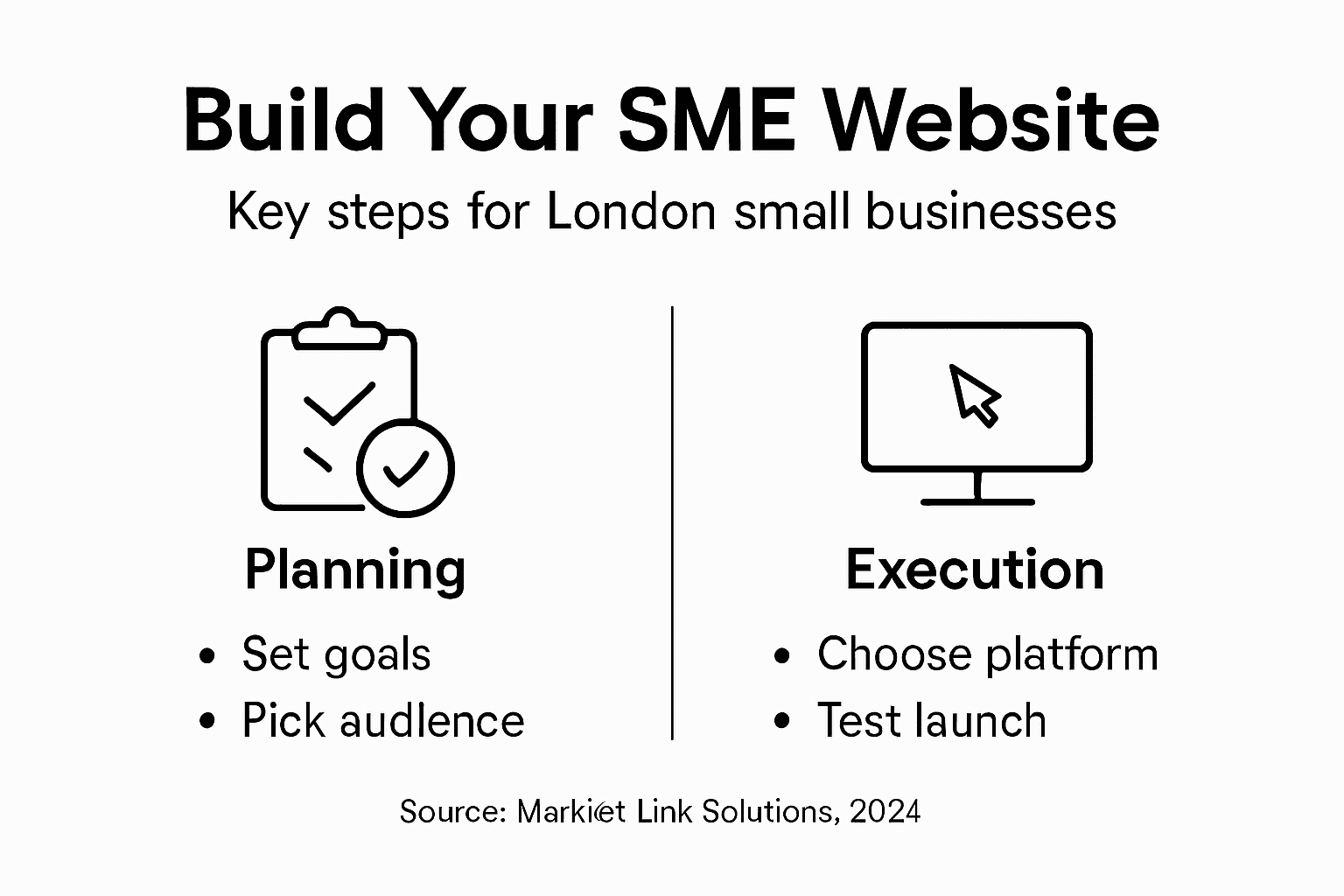
Below is a quick reference for website content types and their primary business benefits:
| Content Type | Purpose | Business Benefit |
|---|---|---|
| Blog Posts | Share insights or news | Improve SEO and engage visitors |
| Service Pages | Detail offerings and solutions | Guide purchase decisions |
| Case Studies | Demonstrate real client success | Build trust and credibility |
| Testimonials | Showcase customer satisfaction | Increase conversion rates |
Pro tip: Use free keyword research tools to identify low-competition, high-relevance search terms specific to your London business niche.
Step 5: Test functionality and launch your site
Launching your business website requires meticulous preparation and thorough testing to ensure a smooth, professional online debut. Your goal is to create a flawless digital experience that reflects your London small business’s commitment to quality and customer service.
Website launch preparation involves comprehensive testing across multiple dimensions to guarantee optimal performance. Your testing checklist should include:
- Cross-browser compatibility testing
- Mobile responsiveness verification
- Load speed performance checks
- Functionality testing of all links and forms
- Security and SSL certificate validation
- Content accuracy and proofreading
Each testing phase helps identify potential issues before your website goes live. Pay particular attention to user experience elements like navigation flow, button responsiveness, and information accessibility. Small technical glitches can significantly impact user perception and potential customer conversion rates.
A well-tested website communicates professionalism and builds immediate customer trust.
Before final launch, conduct a comprehensive review involving team members or trusted colleagues who can provide objective feedback. This external perspective can help uncover usability issues you might have overlooked.
Pro tip: Use free online testing tools like Google’s PageSpeed Insights and mobile-friendly test to identify and resolve technical performance issues before going live.
Take the Stress Out of Building Your London Business Website
Creating a business website for your London SME can feel overwhelming with so many decisions from defining goals to choosing the right platform and optimising content for SEO. If you are struggling with technical choices, design consistency, or attracting local customers, you are not alone. Many small businesses find it challenging to balance professional branding with user-friendly features that convert visitors into loyal clients.
At Market Link Solutions, we understand these key pain points and specialise in helping London small businesses build websites that are not only visually appealing but also tailored to generate qualified leads and increase online presence. Our expertise includes web design and development, PPC advertising on Google and Instagram, and targeted SEO optimisation designed specifically for your local market needs.
Discover how we have guided other businesses like yours by exploring our Success Stories Archives – Digital Marketing Agency – Market Link Solutions.
Ready to elevate your website from a simple digital brochure into a powerful business tool today Choose Market Link Solutions to build a site that truly reflects your brand and connects with your ideal customers Don’t let technical complexity hold you back Contact us now and start transforming your online presence immediately.
Frequently Asked Questions
How can I define my website goals for my London SME?
To define your website goals, start by identifying specific outcomes that align with your overall business strategy, such as generating leads or showcasing your portfolio. Consider conducting brief customer surveys to refine your understanding of what your target audience needs.
What should I consider when choosing a web platform for my small business in London?
When selecting a web platform, evaluate factors like ease of use, customisation options, and mobile responsiveness. Opt for user-friendly choices that allow you to build a professional-looking site without needing extensive technical skills.
How can I create content that is optimised for SEO on my website?
To create SEO-optimised content, research relevant keywords related to your business and include them naturally in your written material. Focus on producing informative, solution-oriented content that addresses your audience’s needs to improve your site’s visibility in search results.
What are the key elements of a user-friendly website design?
A user-friendly website design should include a consistent colour palette, clear typography, intuitive navigation, and high-quality images. Ensure the layout allows for easy access to information and a logical flow that guides visitors towards making an enquiry or purchase.
How do I test my website’s functionality before launching it?
To test your website’s functionality, conduct checks for cross-browser compatibility, mobile responsiveness, and load speed. Ensure that all links and forms work properly, and validate content accuracy to create a professional online presence when you launch.
What steps should I take after launching my business website?
After launching your site, monitor its performance closely, paying attention to user feedback and analytics. Make adjustments as needed to optimise user experience and increase conversion rates; aim to review and update your content and functionality regularly.