
Every London business owner knows the challenge of standing out online among fierce local competition. In today’s digital environment, picking the right keywords is more than guesswork—it is the foundation for connecting your restaurant or aesthetics clinic with nearby customers searching for your exact services. Mastering accurate keyword selection not only improves how search engines find your website, but also helps you reach the audiences who matter most to your business.
Table of Contents
- Defining Keywords And Their SEO Value
- Types Of Keywords For Local Businesses
- How Keyword Research Shapes Search Rankings
- User Intent And The Evolution Beyond Exact Matches
- Mistakes Small Businesses Must Avoid
Key Takeaways
| Point | Details |
|---|---|
| Importance of Keywords | Keywords are essential for SEO, enabling search engines to understand and categorise content, thus improving online visibility for businesses. |
| Types of Keywords | Local businesses should utilise various keyword types, including geo-modified and long-tail keywords, to effectively target potential customers. |
| User Intent Understanding | Comprehending user intent allows businesses to tailor their content in a way that aligns with what customers are searching for, enhancing relevance and traffic. |
| Avoid Common Mistakes | Businesses must avoid pitfalls like keyword stuffing and neglecting local search intent to maintain an effective SEO strategy and improve customer engagement. |
Defining Keywords and Their SEO Value
Keywords represent the fundamental building blocks of search engine optimisation (SEO), acting as critical signposts that help search engines understand and categorise digital content. Understanding keyword fundamentals enables small businesses in London to improve their online visibility and connect with potential customers more effectively.
At their core, keywords are specific words or phrases that encapsulate the primary topics and themes within digital content. For local businesses like restaurants and aesthetic clinics, keywords serve multiple strategic purposes:
- Represent core service offerings
- Signal relevance to search engines
- Match potential customer search queries
- Improve website discoverability
- Target specific geographical markets
The technical mechanism behind keywords involves matching user search intent with relevant content. When a potential customer searches for “aesthetic clinic in London” or “restaurant near Camden”, precise keywords help search engines determine which websites most closely align with those specific queries. This matching process directly influences search ranking positions and organic traffic potential.
Keyword selection requires understanding both technical parameters and user behaviour. Businesses must balance between broad search terms that capture general interest and specific long-tail keywords that target niche customer segments. For instance, a beauty clinic might use keywords like “professional skin treatments” alongside more specific phrases like “microneedling services in North London”.
Pro tip: Conduct monthly keyword research to stay updated with changing search trends and customer language in your specific business sector.
Types of Keywords for Local Businesses
Local keyword strategies play a critical role in helping small businesses in London enhance their digital visibility and attract nearby customers. Understanding the nuanced types of keywords can significantly improve a business’s search engine performance and customer acquisition potential.
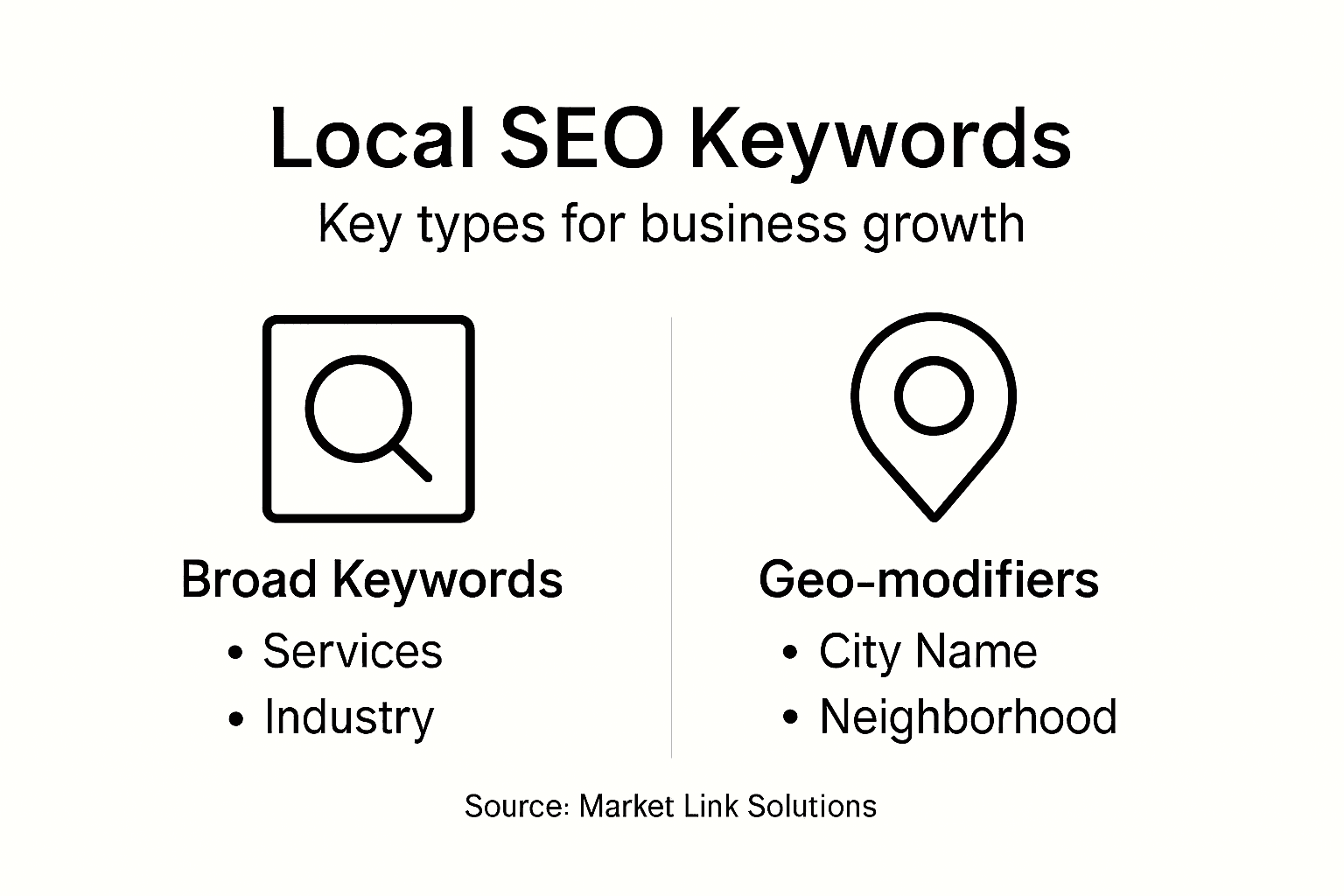
Local keywords can be categorised into several distinct types that serve different strategic purposes:
- Geo-modified keywords: Include specific location names (e.g., “aesthetic clinic in Camden”)
- Service-specific local keywords: Combine service type with location (e.g., “professional skin treatment Hackney”)
- Proximity keywords: Phrases like “near me” or “close to” that signal immediate geographical intent
- Long-tail local keywords: More specific, detailed phrases targeting niche customer segments
- Branded local keywords: Incorporating business name with location (e.g., “Market Link Solutions London”)
For local businesses like restaurants and aesthetic clinics, the key is to develop a keyword strategy that reflects how potential customers actually search. A beauty clinic in North London might target keywords that blend service specificity with geographical precision, such as “microneedling treatment Islington” or “professional skin rejuvenation North London”.

Beyond simple geographical targeting, effective local keywords require understanding user intent. This means anticipating the specific language and search patterns of your target demographic. A restaurant might optimise for keywords that reflect dining preferences, like “best vegan restaurant Shoreditch” or “family-friendly brunch Camden”.
Pro tip: Regularly analyse your website’s search console data to understand which local keywords are already driving traffic and refine your strategy accordingly.
Below is a summary of keyword types and practical use cases for London small businesses:
| Keyword Type | Example Usage | Unique Value |
|---|---|---|
| Geo-modified | Clinic in Camden | Targets local searches |
| Service-specific local | Skin treatment Hackney | Attracts intent-based visitors |
| Proximity | Near me for brunch | Captures spontaneous demand |
| Long-tail local | Vegan roast Islington | Draws niche clientele |
| Branded local | Market Link Solutions London | Reinforces business identity |
How Keyword Research Shapes Search Rankings
Keyword selection strategies fundamentally determine a website’s ability to rank effectively in search engine results. For small businesses in London, understanding how keyword research impacts search rankings can mean the difference between digital invisibility and attracting potential customers.
Keyword research involves several critical components that directly influence search engine performance:
- Search volume: Identifying how frequently specific terms are searched
- Competitive difficulty: Assessing how challenging it is to rank for particular keywords
- User intent: Understanding the underlying motivation behind search queries
- Relevance: Matching keywords precisely to website content
- Long-tail potential: Exploring more specific, less competitive keyword variations
Search engines like Google use sophisticated algorithms that evaluate keywords across multiple dimensions. They analyse not just the presence of keywords, but their contextual relevance, frequency, and alignment with user search intent. A restaurant in Shoreditch, for example, would benefit from keywords that blend specific service descriptions with geographical modifiers, such as “best vegan Sunday roast in East London”.
The technical nuances of keyword research extend beyond simple word matching. Modern search algorithms consider semantic relationships, meaning they understand conceptual connections between terms. This requires businesses to think strategically about keyword clusters and related phrases that comprehensively represent their services and local market positioning.
Pro tip: Use free Google search console tools to track your current keyword performance and identify emerging search trends relevant to your business.
User Intent and The Evolution Beyond Exact Matches
Semantic search strategies represent a transformative approach to understanding how users interact with digital content, moving far beyond traditional keyword matching. For small businesses in London, comprehending this evolution means adapting marketing strategies to meet increasingly sophisticated search engine algorithms.
User intent can be categorised into several critical dimensions:
- Informational intent: Seeking knowledge or answers
- Navigational intent: Looking for a specific website or page
- Transactional intent: Preparing to make a purchase or book a service
- Commercial investigation intent: Comparing options before deciding
- Local intent: Searching for services within a specific geographical area
Modern search technologies now employ advanced natural language processing techniques that interpret context and nuance. A restaurant in Shoreditch isn’t just matching keywords like “Sunday lunch”, but understanding whether a user wants a booking, menu information, reviews, or pricing details. This sophisticated approach allows search engines to deliver more precise, relevant results that genuinely match user expectations.
The technical complexity of user intent goes beyond simple word recognition. Search algorithms now use machine learning to understand semantic relationships, contextual cues, and implied meanings. This means businesses must create content that comprehensively addresses potential user questions and demonstrates deep, contextual understanding of their services.
Pro tip: Develop content that answers multiple layers of user intent, not just surface-level keyword matches.
This table compares how search engines traditionally matched keywords versus the modern, semantic approach:
| Approach | Core Mechanism | Benefit for Small Businesses |
|---|---|---|
| Exact match | Matches identical words | Basic visibility boost |
| Semantic search | Understands context and intent | Delivers highly relevant traffic |
Mistakes Small Businesses Must Avoid
Common website design mistakes can significantly undermine a local business’s digital marketing efforts. For small enterprises in London, understanding and avoiding these pitfalls is crucial to maintaining a competitive online presence and attracting potential customers.
Keyword-related mistakes that small businesses frequently make include:
- Keyword stuffing: Overloading content with repetitive keywords
- Ignoring local search intent: Failing to incorporate location-specific phrases
- Using generic, broad keywords: Missing opportunities for targeted marketing
- Neglecting long-tail keywords: Overlooking specific, niche search terms
- Inconsistent keyword usage: Lacking strategic, uniform keyword implementation
Many London-based businesses struggle with understanding the nuanced approach required for effective SEO. A beauty clinic in Camden, for instance, might mistakenly use generic terms like “beauty treatment” instead of specific, localised phrases such as “professional microneedling in Camden” that directly target potential local clients.
The most critical error is treating keywords as a technical checkbox rather than a strategic communication tool. Successful SEO requires understanding the subtle interplay between search terms, user intent, and content relevance. This means creating genuine, informative content that naturally incorporates keywords, rather than forcing them into unnatural sentence structures.
Pro tip: Conduct a monthly audit of your website’s keyword strategy, focusing on alignment with current local search trends and user intent.
Unlock Your Local Growth Potential with Expert SEO Support
Understanding the vital role that keywords play in SEO is just the beginning. The real challenge for small businesses in London lies in crafting the right keyword strategy to capture local intent and stand out in a competitive market. If you find yourself struggling with pinpointing the best geo-modified or long-tail keywords, or consistently addressing complex user intent to improve your search rankings, you are not alone. These hurdles can prevent your business from reaching customers ready to engage and convert.
At Market Link Solutions, we specialise in helping small London businesses overcome these exact challenges. Our team offers tailored SEO optimisation, combined with web design and PPC advertising that ensures your keywords drive meaningful traffic. See how we have transformed local businesses by exploring our Success Stories Archives – Digital Marketing Agency – Market Link Solutions.
Ready to harness the full power of effective keyword research and local SEO? Visit Market Link Solutions now and take the first step towards growing your business with expert digital marketing solutions designed for your unique London market. Discover how our web design and development and PPC advertising services work together to amplify your reach. Don’t wait to transform your online presence and start attracting the customers you deserve.
Frequently Asked Questions
What are keywords in SEO, and why are they important?
Keywords are specific words or phrases that encapsulate the main topics of your content. They help search engines understand and categorise your website, thereby improving your visibility and relevance to potential customers.
How can local businesses effectively choose keywords for their SEO strategy?
Local businesses should focus on combining service descriptions with geographical modifiers, such as “aesthetic clinic in Camden” or “family-friendly brunch” to attract nearby customers. Regular keyword research is also essential to stay updated with search trends.
What is the difference between broad keywords and long-tail keywords?
Broad keywords capture general interest and are more competitive, while long-tail keywords are more specific phrases that target niche markets and generally have lower competition, making them easier to rank for in search engines.
How do I analyse keyword performance for my website?
Utilise tools such as Google Search Console to track which keywords are driving traffic to your website and assess search volume, competitive difficulty, and user intent to refine your keyword strategy.