
Most british small businesses do not realise that over 90 percent of consumers search for local services online before making a decision. With the competitive pulse of London, restaurant and aesthetics clinic owners must master SEO content if they want to stand out. This guide reveals practical strategies to help your business attract the right customers, build trust, and transform your website into a reliable asset for long-term visibility in the british market.
Table of Contents
- Defining SEO Content for Small Businesses
- Essential Types of SEO Content
- How Content Drives Website Rankings
- Local Content Strategies for London SMEs
- Common Mistakes and Proven Solutions
Key Takeaways
| Point | Details |
|---|---|
| Understanding SEO Content | Small businesses should prioritise creating high-quality, engaging content that satisfies both customer queries and search engine algorithms. |
| Importance of Local SEO | Tailoring content with location-specific keywords enhances visibility and connection with local audiences in London. |
| Diverse Content Types | Utilising various content forms like long-form articles, interactive tools, and video content can significantly boost user engagement and SEO performance. |
| Avoiding Common Mistakes | Regularly update local business listings and ensure mobile optimisation to improve search rankings and user experience. |
Defining SEO Content for Small Businesses
Small business owners in London must understand that SEO content represents strategic digital communication designed to improve online visibility and attract targeted local customers. Effective SEO content strategies require a nuanced approach that goes beyond simple keyword placement, focusing instead on creating valuable information that addresses genuine customer queries and interests.
At its core, SEO content for small businesses involves developing purposeful digital assets that simultaneously serve two critical functions: engaging human readers and satisfying search engine algorithms. This means crafting website pages, blog posts, and digital resources that answer specific customer questions while incorporating relevant keywords naturally. Small businesses must prioritise content that demonstrates expertise, builds trust, and provides clear solutions to potential clients’ challenges.
Successful local SEO content follows specific strategic principles. These include understanding the precise needs of your target audience, researching location-specific search terms relevant to London businesses, and creating informative materials that showcase your unique value proposition. High-quality content should address customer pain points, highlight your specific expertise, and include location-based keywords that help search engines understand your business’s geographical relevance.
Pro tip: Conduct monthly content audits to ensure your digital materials remain current, relevant, and aligned with your target audience’s evolving search behaviours.
Essential Types of SEO Content
Small businesses looking to enhance their digital presence must understand the diverse range of SEO content types available to improve their online visibility. These content formats serve distinct purposes in attracting and engaging potential customers, each playing a unique role in the digital marketing ecosystem. The strategic selection and implementation of different content types can significantly impact a business’s ability to rank higher in search engine results and connect with their target audience.
The primary types of SEO content include long-form articles, which provide comprehensive insights into specific topics, and short-form content that delivers quick, digestible information. Pillar pages serve as comprehensive resource hubs covering broad topics in-depth, while how-to guides offer practical, step-by-step solutions to specific customer challenges. For London-based small businesses, local SEO content becomes particularly crucial, incorporating location-specific keywords and addressing the unique needs of the local market.
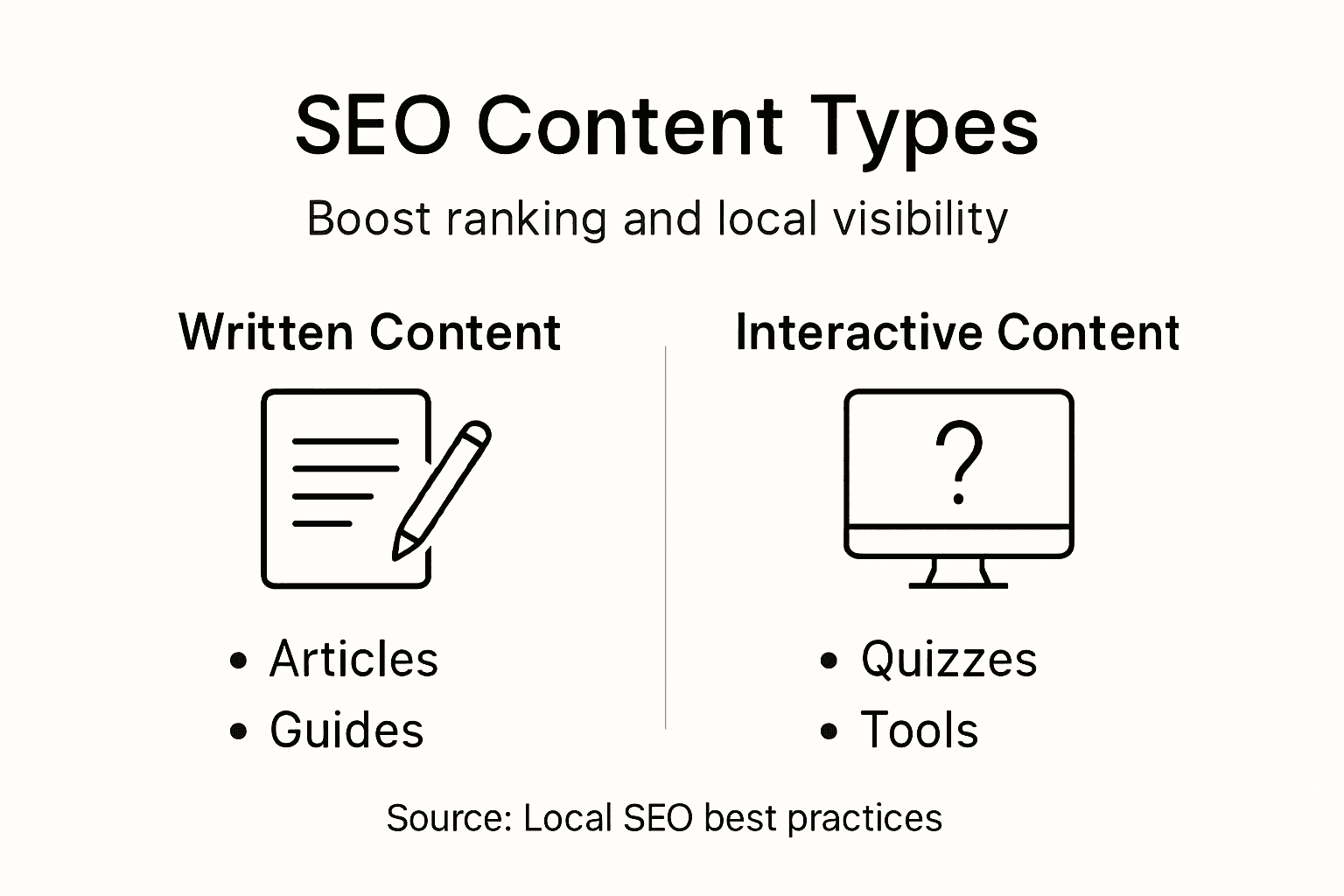
Interactive content represents another powerful SEO strategy, engaging users through tools, quizzes, calculators, or dynamic resources that encourage longer website interactions. Video content has emerged as a particularly effective medium, allowing businesses to showcase expertise, explain complex concepts, and improve user engagement. Each content type should be carefully crafted to balance informative value, keyword optimization, and genuine user experience, ensuring that the material not only ranks well but also provides real value to potential customers.
Pro tip: Develop a content matrix that maps different content types to specific stages of your customer journey, ensuring comprehensive coverage and targeted engagement.
Here’s a comparison of key SEO content types and their advantages for small businesses:
| Content Type | Typical Use Case | Business Impact |
|---|---|---|
| Long-form Articles | Explaining in-depth topics | Builds authority, boosts ranking |
| Pillar Pages | Central resource on a subject | Supports internal linking, improves site structure |
| Local SEO Content | Targeting city or neighbourhood searches | Increases local customer reach |
| Interactive Tools | Engaging visitors with calculators/quizzes | Increases time on site, enhances engagement |
| Video Content | Demonstrating expertise visually | Improves conversions, attracts diverse audiences |
| How-to Guides | Step-by-step customer solutions | Drives targeted traffic, answers specific queries |
How Content Drives Website Rankings
Understanding how content fuels website growth is crucial for small businesses seeking to improve their online visibility. Search engines like Google prioritise websites that consistently produce high-quality, relevant content that addresses user queries and demonstrates expertise. The intricate relationship between content quality and search engine rankings means that businesses must develop strategic approaches to content creation that go beyond simple keyword insertion.

The mechanism of content driving website rankings involves several key components. Organic traffic is generated through well-researched, informative content that directly answers user questions and provides genuine value. This approach signals to search algorithms that a website is authoritative and trustworthy. Keyword relevance plays a critical role, with content that naturally incorporates search terms matching user intent ranking higher in search results. For London-based small businesses, this means creating localised content that speaks directly to the specific needs and interests of their target audience.
User engagement metrics represent another crucial factor in content-driven rankings. Websites that produce content encouraging longer visit durations, lower bounce rates, and higher interaction levels are rewarded with improved search positions. This involves creating diverse content types – from in-depth articles and practical guides to interactive elements and multimedia resources – that keep visitors engaged and exploring the website. The goal is to create a comprehensive resource that not only attracts visitors but also provides them with meaningful, actionable information.
Pro tip: Conduct regular content audits to identify and refresh underperforming pages, ensuring your website maintains high-quality, current, and relevant information.
Local Content Strategies for London SMEs
London small and medium enterprises (SMEs) are increasingly leveraging AI-driven digital marketing strategies to create targeted, localised content that resonates with their specific audience. Developing a robust local content strategy requires understanding the unique characteristics of the London market, including neighbourhood-specific nuances, local customer preferences, and hyper-localised search behaviours that distinguish metropolitan marketing approaches.
Effective local content strategies for London SMEs centre on creating hyperlocal content that speaks directly to specific London neighbourhoods and communities. This approach involves developing content that incorporates local landmarks, references specific London districts, and addresses region-specific challenges and interests. Neighbourhood-specific keywords become critical, with businesses tailoring their content to include references to areas like Shoreditch, Hackney, Camden, or specific borough names that help improve local search visibility and connect more authentically with potential customers.
Technology plays a significant role in enhancing local content strategies, with AI and data analytics enabling more precise targeting and personalisation. Small businesses can leverage tools that analyse local search trends, customer behaviour patterns, and geographic search data to create more responsive and relevant content. This might include developing location-specific landing pages, creating content that addresses local events or seasonal considerations unique to London, and developing multimedia resources that showcase the business’s understanding of the local community’s specific needs and interests.
Pro tip: Develop a content calendar that incorporates local events, seasonal trends, and neighbourhood-specific insights to maintain relevance and engagement with your local London audience.
Common Mistakes and Proven Solutions
Small businesses often encounter critical challenges when implementing local SEO strategies, with common SEO mistakes hindering their online visibility and potential customer engagement. Understanding these pitfalls is crucial for developing a robust digital marketing approach that effectively connects with local audiences and improves search engine rankings.
One of the most significant errors is neglecting local business listings, particularly Google Business Profile management. Many London SMEs fail to claim, verify, and regularly update their local listings, which dramatically reduces their chances of appearing in local search results. Proven solutions involve comprehensive profile optimization, including accurate business information, high-quality images, regular updates, and encouraging genuine customer reviews that demonstrate local credibility and trustworthiness.
Mobile optimization represents another critical area where small businesses frequently stumble. With increasing numbers of customers using mobile devices for local searches, websites that are not responsive or mobile-friendly can lose significant potential traffic. Successful strategies include implementing responsive design, ensuring fast loading speeds, creating mobile-friendly content layouts, and providing easy navigation that works seamlessly across different device types. By prioritising mobile user experience, businesses can significantly improve their local search rankings and customer engagement.
To help avoid common pitfalls, here is a summary of frequent SEO mistakes and recommended solutions for London SMEs:
| Common Mistake | Why It Hurts SEO | Recommended Solution |
|---|---|---|
| Ignoring local business listings | Reduces local visibility | Fully optimise and update profiles |
| Inadequate mobile optimisation | Poor user experience on phones | Ensure responsive, quick, easy navigation |
| Outdated or inconsistent information | Erodes trust and rankings | Conduct regular content and SEO audits |
Pro tip: Conduct a quarterly technical SEO audit to identify and quickly address any mobile responsiveness, page speed, or local listing issues that might be impacting your search visibility.
Elevate Your Local Visibility with Expert SEO Content Strategies
Small businesses in London often struggle to boost their online presence due to challenges like neglecting local business listings and lacking mobile optimisation. This article highlights how targeted, high-quality SEO content tailored to local audiences can dramatically improve your website rankings and attract the right customers. By focusing on local SEO content, hyperlocal keywords, and interactive elements, you can engage visitors meaningfully while satisfying search engine algorithms.
Discover how our London-based digital marketing agency specialises in solving these exact pain points. We help small businesses build customised websites, optimise their SEO with precise local targeting, and run effective PPC campaigns on platforms such as Google and Instagram—all designed to amplify your online reach.
Unlock the potential of content that not only ranks well but converts visitors into loyal customers. See how we have transformed London small businesses by visiting our Success Stories Archives – Digital Marketing Agency – Market Link Solutions.
Ready to overcome your visibility challenges now We invite you to explore how our expert team can tailor a winning digital presence for your business Visit Market Link Solutions today and take the first step towards sustained growth driven by exceptional SEO content and strategic digital marketing.
Frequently Asked Questions
What is SEO content, and why is it important for small businesses?
SEO content involves creating digital materials designed to improve online visibility and attract targeted customers. For small businesses, it is essential as it helps connect with potential clients, enhances authority, and boosts organic traffic.
How can local SEO content improve a business’s visibility in search engines?
Local SEO content tailored to specific geographical areas enhances visibility by incorporating location-specific keywords and addressing local customer needs, which helps search engines recognise a business’s relevance to local searches.
What types of content are most effective for SEO?
Effective types of SEO content include long-form articles for in-depth insights, pillar pages for comprehensive resources, local content for targeting area-specific searches, interactive tools for engagement, video content for showcasing expertise, and how-to guides for practical solutions.
How can small businesses avoid common SEO mistakes?
To avoid common SEO mistakes, small businesses should ensure they claim and regularly update local listings, optimise their websites for mobile users, and conduct regular content audits to keep information accurate and current.