
Every british business owner knows the digital marketplace is more crowded than ever. With over 90 percent of consumers starting their search for products or services online, ignoring search engine optimisation can mean missing out on valuable customers. Small businesses in London and across the UK rely on smart SEO strategies to boost visibility, reach local audiences, and build credibility online. This guide reveals why effective SEO is more than a marketing trend and how it can drive measurable business growth for british companies.
Table of Contents
- Defining SEO And Its Business Impact
- Key Types Of SEO Strategies Explained
- How SEO Grows Small London Businesses
- Common SEO Mistakes And How To Avoid Them
- Assessing Costs, ROI, And Ongoing Commitment
Key Takeaways
| Point | Details |
|---|---|
| Importance of SEO | SEO enhances online visibility, attracting more potential customers through organic search results, crucial for small businesses competing in the digital landscape. |
| Types of SEO Strategies | Key strategies include Technical SEO for backend optimisation, Content SEO for creating relevant content, and Local SEO to target geographical searches effectively. |
| Long-term Commitment | SEO requires ongoing investment and adaptation, with results typically emerging after sustained efforts, making it critical for businesses to treat it as a long-term strategy. |
| Avoid Common Mistakes | Businesses should avoid keyword mismanagement, neglecting technical elements, and producing low-quality content to improve their online performance effectively. |
Defining SEO and Its Business Impact
Search engine optimisation (SEO) represents a strategic digital marketing approach designed to enhance a business’s online visibility and attract more potential customers through organic search results. According to Startups.co.uk, SEO is critical for small businesses seeking to establish a strong digital presence and compete effectively in today’s online marketplace.
At its core, SEO involves optimising website content, structure, and technical elements to rank higher on search engine results pages (SERPs). As Enterprise Nation highlights, this process directly influences how potential customers discover and interact with a business online. The primary goal is straightforward: improve your website’s visibility so more people can find your products or services when searching for relevant keywords.
For small businesses in London, SEO offers several transformative benefits:
- Increased website traffic from targeted local searches
- Enhanced brand credibility and online reputation
- Cost-effective marketing compared to traditional advertising
- Improved user experience and website performance
- Higher conversion rates from qualified leads
Implementing a robust SEO strategy isn’t just about technical tweaks. It’s about understanding your target audience, creating valuable content, and positioning your business as an authoritative solution to potential customers’ needs. Content SEO: Rank Higher with High-Quality, Keyword-Rich Content can provide deeper insights into crafting compelling, search-friendly content that drives real business results.
Key Types of SEO Strategies Explained
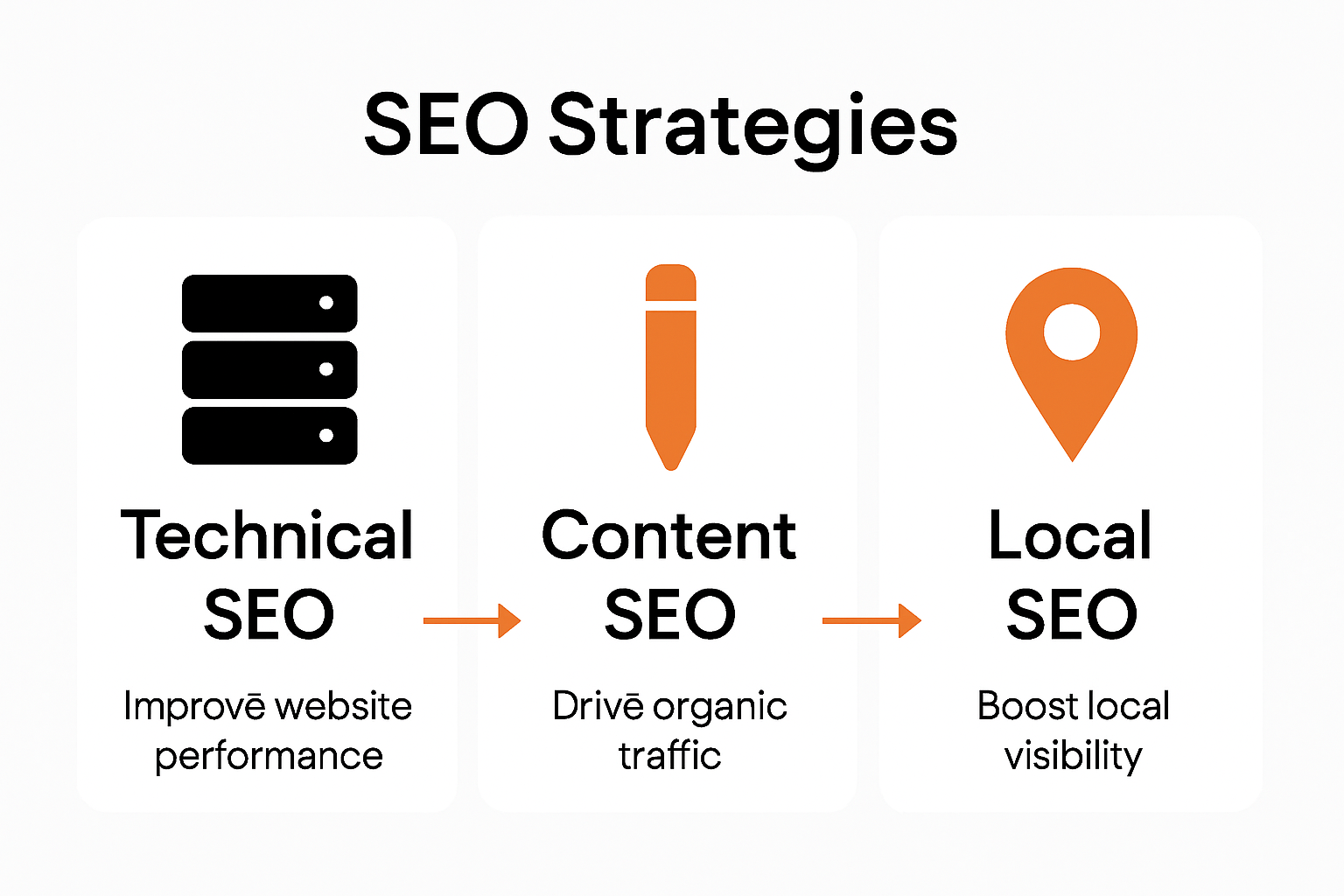
Search engine optimisation comprises multiple strategic approaches designed to improve a website’s online performance and visibility. Enterprise Nation highlights several critical SEO strategies that small businesses can leverage to enhance their digital presence and attract more potential customers.
Technical SEO focuses on optimising a website’s backend infrastructure, ensuring search engines can efficiently crawl, index, and understand site content. This involves improving site speed, mobile responsiveness, secure connections, and clean website architecture. Key technical elements include:
- Optimising page loading times
- Creating a logical site structure
- Implementing proper meta tags and descriptions
- Ensuring mobile-friendly design
- Fixing broken links and redirects
Content SEO represents another crucial strategy, concentrating on creating high-quality, relevant content that answers user queries and incorporates strategic keywords. This approach involves developing informative blog posts, service pages, and resources that demonstrate expertise while naturally integrating search terms potential customers might use.
For local London businesses, local SEO becomes particularly important. This strategy targets geographical-specific searches, helping businesses appear in localised search results and Google Maps listings. By Why SEO for Small Businesses: Complete Guide, implementing location-based keywords, maintaining consistent business information across online directories, and encouraging customer reviews can significantly boost local search visibility and attract nearby customers.
How SEO Grows Small London Businesses
For small businesses in London, search engine optimisation represents a powerful strategy to drive growth, attract local customers, and compete effectively in a crowded digital marketplace. Essential Guide to Local SEO London for Small Businesses demonstrates how targeted SEO approaches can transform a small business’s online visibility and customer acquisition potential.
Digital Visibility is the cornerstone of business growth in today’s competitive landscape. By implementing strategic SEO techniques, London-based businesses can:
- Appear in top search results for local queries
- Attract customers actively searching for their specific services
- Build credibility and trust through consistent online presence
- Compete with larger businesses despite limited marketing budgets
- Generate high-quality leads without expensive advertising
Local SEO strategies are particularly crucial for small businesses targeting London customers. This involves optimising Google My Business listings, collecting local customer reviews, and creating location-specific content that resonates with the local market. When potential customers search for services “near me” or specific to London, a well-optimised website increases the likelihood of being discovered.

Technical performance plays a critical role in SEO success. Technical SEO: Making London Websites Faster, Stronger & Ready to Rank highlights how website speed, mobile responsiveness, and user experience directly impact search rankings. Small businesses that invest in robust technical SEO can significantly improve their online visibility, attract more local customers, and ultimately drive business growth in the competitive London market.
Common SEO Mistakes and How to Avoid Them
Enterprise Nation highlights several critical SEO mistakes that can significantly undermine a small business’s online performance. Understanding and addressing these common pitfalls is essential for developing an effective digital marketing strategy that drives genuine results.
Keyword Mismanagement represents one of the most prevalent SEO errors small businesses encounter. Many entrepreneurs either stuff their content with irrelevant keywords or choose overly competitive search terms that make ranking impossible. The key is selecting strategic, targeted keywords that:
- Match actual customer search behaviours
- Have reasonable competition levels
- Align closely with your specific business offerings
- Demonstrate clear user intent
- Balance search volume with ranking potential
Another significant mistake involves neglecting technical website elements. Why Your SEO Isn’t Working emphasises that poor mobile responsiveness, slow loading speeds, and inconsistent business information can dramatically reduce search engine rankings. Small businesses must prioritise website infrastructure, ensuring seamless performance across all devices and maintaining accurate, consistent contact details across online platforms.
The final critical error is producing low-quality, generic content that fails to provide genuine value to potential customers. Search engines increasingly prioritise websites that offer comprehensive, authoritative information addressing specific user needs. Successful SEO requires creating targeted, informative content that genuinely helps your audience while naturally incorporating relevant keywords and demonstrating industry expertise.
Assessing Costs, ROI, and Ongoing Commitment
Enterprise Nation emphasises that search engine optimisation is not a one-time expense but a strategic investment requiring consistent financial and time resources. Small businesses must approach SEO as a long-term commitment, understanding that meaningful results typically emerge after sustained, strategic efforts.
Budget Considerations for SEO can vary significantly depending on business size and complexity. Most small London businesses can expect to invest between £500 to £2,000 monthly, which might include:
- Professional SEO consultancy services
- Content creation and keyword research
- Technical website optimisation
- Ongoing performance monitoring
- Local search strategy development
Return on Investment (ROI) should be measured through multiple performance indicators. Startups.co.uk recommends tracking metrics such as organic website traffic, conversion rates, keyword rankings, and most importantly, the actual revenue generated from search engine visitors. Successful SEO strategies can potentially deliver a 200-300% return within 6-12 months, transforming initial investments into substantial business growth.
The critical aspect of SEO commitment lies in consistency and adaptability. Search engine algorithms constantly evolve, requiring businesses to regularly update their strategies, refresh content, and maintain technical website performance. Small businesses that treat SEO as an ongoing process rather than a quick fix will see the most significant and sustainable digital marketing results.
Unlock Your Business Potential with Expert SEO Support
Navigating the complex world of SEO can be daunting for small London businesses aiming to boost their online visibility and attract local customers. You may be struggling with technical SEO challenges, ineffective keyword strategies, or simply not seeing the return on investment you expected. Understanding these pain points is the first step in transforming your website into a powerful customer magnet. Our London-based digital marketing agency specialises in Web Design and Development, PPC Advertising, and SEO Optimisation — tailored specifically to help small businesses grow steadily and sustainably.
Discover how others have successfully overcome these challenges by exploring our Success Stories Archives – Digital Marketing Agency – Market Link Solutions.
Take control of your digital future today with a partner who knows the local market and is dedicated to long-term growth. Visit https://market-link.co.uk now and start turning your website into your most valuable business asset.
Frequently Asked Questions
What is SEO and why is it important for businesses?
SEO, or search engine optimisation, is a strategic marketing approach that enhances a business’s online visibility and attracts potential customers through organic search results. It’s crucial for businesses to compete effectively and establish a strong digital presence in today’s marketplace.
How can SEO benefit small businesses?
SEO can significantly benefit small businesses by increasing website traffic from targeted local searches, enhancing brand credibility, and providing a cost-effective marketing alternative to traditional advertising. It also improves user experience and can lead to higher conversion rates.
What are the main types of SEO strategies?
The main types of SEO strategies include technical SEO, which focuses on the website’s backend infrastructure; content SEO, which involves creating high-quality and relevant content; and local SEO, which targets geographical searches to help businesses appear in local search results and Google Maps listings.
How can small businesses avoid common SEO mistakes?
To avoid common SEO mistakes, small businesses should focus on strategic keyword management, maintain their website’s technical elements like loading speed and mobile responsiveness, and produce high-quality, valuable content that meets users’ needs and aligns with search intent.
Recommended
- Why SEO for Small Businesses: Complete Guide – Digital Marketing Agency – Market Link Solutions
- The Future of SEO: Predictions and Strategies for Small Businesses – Digital Marketing Agency – Market Link Solutions
- Essential Guide to Local SEO London for Small Businesses
- Why Your SEO Isn’t Working (and How to Fix It for Small Businesses in London)