
Growing a small business in London means standing out where everyone is searching for their next meal or treatment online. For restaurants and aesthetics clinics alike, your website is far more than just a digital menu or price list. Research shows that websites act as platforms for interaction, reducing transaction costs and helping businesses connect directly with customers. Choosing the right features, design, and strategy can make your website work for you by attracting the right visitors and turning them into loyal clients.
Table of Contents
- Defining a Website’s Role for SMEs
- Types of Business Websites in London
- Key Website Features for Growth
- Digital Marketing: SEO and PPC Strategies
- Legal Compliance for UK Small Business Sites
- Common Pitfalls and How to Avoid Them
Key Takeaways
| Point | Details |
|---|---|
| Website as an Essential Tool | A website serves as a key infrastructure for SMEs, influencing customer interactions and decisions. It should be actively maintained and optimised for search engines and mobile devices. |
| Type of Website Matters | Choosing the appropriate type of website—be it branding, e-commerce, or hybrid—is crucial for aligning with customer expectations and business goals. |
| Focus on User Experience | Prioritise features that enhance customer interaction, such as speed, mobile responsiveness, and clear booking functionalities. Simplify navigation to improve conversion rates. |
| Legal Compliance is Critical | SMEs must adhere to legal regulations, including data protection and accessibility, to maintain customer trust and avoid potential penalties. |
Defining a Website’s Role for SMEs
Your website isn’t just a digital business card gathering dust online. For small and medium-sized enterprises (SMEs) in London, a website functions as a critical piece of infrastructure that shapes how customers find you, interact with your business, and ultimately decide whether to choose you over competitors. The research shows that websites act as platforms for interaction, reducing transaction costs and enabling direct customer engagement. Whether you run a restaurant serving Friday night crowds in Soho or an aesthetics clinic in Mayfair, your website is often the first impression potential customers have of your business.
For restaurant and aesthetics businesses specifically, your website serves three distinct but interconnected purposes. First, it acts as your shop window, showcasing your menu, service offerings, treatment packages, and the atmosphere clients can expect. Second, it’s a conversion tool that turns curious browsers into actual customers through online booking systems, contact forms, and clear calls to action. Third, it provides essential business infrastructure by listing your location, opening hours, contact details, and accepting payments or reservations without requiring staff to field every enquiry manually. The Enterprise Research Centre highlights that websites provide essential digital infrastructure allowing SMEs to interact with customers and streamline business processes, which directly enables innovation and growth in your operation.
However, simply having a website isn’t enough. Many London SMEs launch sites and then watch them fade into irrelevance because they’re not actively maintained, not optimised for search engines, or not designed to work smoothly on mobile devices (which is where most restaurant and aesthetics customers browse). A well-functioning website aligned with your growth strategy generates qualified leads, builds credibility in a crowded marketplace, and provides measurable data about what customers actually want from your business. When you understand what role your website should play in your specific business, you can invest strategically in the right features and marketing approaches rather than spreading resources too thinly.
Pro tip: Audit your current website against customer journeys in your industry—if someone searches for “best sushi in King’s Cross” or “HydraFacial near me,” can they easily book with you, or does your site send them elsewhere?
Types of Business Websites in London
Not all websites serve the same purpose, and choosing the wrong type for your London business can waste thousands of pounds and months of effort. Your website needs to match what your business actually does and how customers want to interact with you. Understanding the different types of websites and their specific functions helps you make strategic decisions about design, features, and ongoing investment. For restaurant and aesthetics businesses in London, this distinction becomes critical because your customer journey looks completely different from, say, a software company or a B2B manufacturing firm.
The most common type for hospitality and service businesses is the branding and engagement website, which focuses on showcasing your business identity, building trust, and converting visitors into customers. Your restaurant website might feature high quality food photography, customer testimonials, your chef’s story, and multiple booking pathways. An aesthetics clinic website showcases treatment results, staff credentials, before and after galleries, and detailed service descriptions. These sites prioritise customer experience and make booking or purchasing services straightforward. Then there’s the e-commerce website, which handles direct online sales. Whilst fewer restaurants use full e-commerce, many London aesthetics clinics now offer product sales alongside services, selling skincare ranges or treatment packages online. Finally, portfolio websites work best for independent aestheticians or personal training consultants who need to display their work and attract new clients through visual proof of expertise.
For most London SMEs in restaurants and aesthetics, you’ll likely need a hybrid approach combining branding, booking functionality, and potentially some e-commerce elements. A restaurant needs beautiful imagery and atmosphere alongside a reservation system and menu availability. An aesthetics clinic needs service showcases alongside appointment booking and potentially product sales. The trap many London business owners fall into is building a generic website that attempts everything without excelling at anything. Your site should prioritise what drives actual revenue. If your primary income comes from bookings, your website architecture should make booking impossibly easy. If you sell products, your checkout process needs to be frictionless. If you’re building brand authority, your content and visuals need professional polish.
Here is a comparison of common website types for London SMEs in restaurants and aesthetics:
| Website Type | Primary Function | Typical Features | Suitable For |
|---|---|---|---|
| Branding & Engagement | Build trust and showcase | Visual galleries, testimonials | Restaurants and clinics prioritising brand authority |
| E-commerce | Sell products or packages | Online shop, secure checkout | Aesthetics clinics selling products |
| Portfolio | Demonstrate expertise | Before/after images, credentials | Independent consultants or freelancers |
| Hybrid | Combine branding and sales | Bookings, product sales, content | Most restaurant and clinic SMEs |
Pro tip: Identify your top three revenue-generating activities (booking appointments, selling products, building brand authority) and audit whether your website makes each of these at least three clicks or fewer from any page.
Key Website Features for Growth
Your website’s features determine whether it attracts customers or drives them away. Not every feature matters equally, and adding unnecessary complexity often harms growth more than it helps. The most effective websites for London SMEs focus on a lean set of features that directly support customer decision-making and conversion. For restaurants and aesthetics businesses, this means prioritising features that address your customer’s immediate need: finding you, learning what you offer, and booking or purchasing quickly.

Speed and mobile responsiveness rank at the top of your feature priority list. When someone searches for “best aesthetics clinic near me” on their phone while waiting in traffic, your site has roughly three seconds to load before they move to a competitor. Responsive design isn’t a luxury anymore; it’s foundational. Your website must work perfectly on smartphones, tablets, and desktops because over 70 percent of London customer searches now happen on mobile devices. Beyond speed, clear booking or contact functionality should appear above the fold on every page. A restaurant website needs visible reservation options; an aesthetics clinic needs obvious “Book Now” buttons. These shouldn’t be buried in navigation menus or hidden behind multiple clicks.
Customer social proof and content drive growth by building trust. High-quality photographs of your food, treatment results, or clinic environment create emotional connections that text alone cannot achieve. Customer testimonials and reviews provide reassurance, particularly important for aesthetics businesses where people are evaluating whether to trust someone with their appearance. Your website should display Google reviews, client testimonials, or before-and-after galleries prominently. SEO-optimised content is another critical feature that many London SMEs overlook. Your website pages need to address the specific searches potential customers actually make. A restaurant website needs content optimised for “Italian restaurant Clerkenwell” or “Sunday roast Islington.” An aesthetics clinic needs pages optimised for “HydraFacial London” or “microneedling treatment near me.” Without this optimisation, even a beautifully designed website remains invisible to the customers searching for exactly what you offer.
Pro tip: Audit your website’s core features by asking: Can someone book an appointment or make a purchase in fewer than four clicks? Does it load within three seconds on a mobile phone? Are your best images and customer reviews visible without scrolling?
Digital Marketing: SEO and PPC Strategies
A website without traffic is like a restaurant with great food and an invisible storefront. Your website needs customers to find it, and that’s where SEO and PPC strategies become essential for growth. These two approaches work differently but serve the same ultimate goal: connecting your London business with people actively searching for what you offer. Many small business owners treat these as either/or decisions, but the most effective approach uses both in tandem. Understanding SEO versus PPC helps you allocate your marketing budget strategically based on your business stage, competitive landscape, and growth timeline.
SEO (Search Engine Optimisation) is your long-term growth engine. When someone searches for “Italian restaurant Fitzrovia” or “acne treatment Bethnal Green,” SEO ensures your website appears in organic search results without paying per click. SEO takes time, typically three to six months before you see meaningful results, but the payoff compounds. Once your website ranks well for valuable search terms, you receive consistent traffic without ongoing advertising costs. For London restaurants and aesthetics clinics, SEO means optimising your website content around the specific searches your customers make. An aesthetics clinic should target searches like “non-invasive facelift London” or “skin rejuvenation treatment near me.” A restaurant should optimise for location-specific searches combined with cuisine type. The challenge with SEO is patience; it requires consistent effort and the competitive landscape in London means ranking for popular terms takes genuine expertise.
PPC (Pay-Per-Click) advertising, primarily through Google Ads, delivers immediate results. You create ads that appear at the very top of search results, and you only pay when someone clicks your ad. For a new restaurant or aesthetics clinic launching in London, PPC provides instant visibility whilst your SEO efforts build momentum. You control your budget precisely, set daily spending limits, and can pause campaigns immediately if they’re not generating profitable bookings. The downside is cost; competitive keywords in London can become expensive, particularly for popular aesthetics treatments. However, PPC advantages for London small businesses include measurable ROI, rapid testing of messaging, and the ability to target specific customer demographics and locations.
The optimal strategy combines both approaches. Use PPC to generate immediate bookings and revenue whilst your SEO efforts mature. Run PPC campaigns on your most profitable services or high-intent keywords, then gradually shift budget towards SEO as your organic rankings improve. For example, a new aesthetics clinic might spend 70 percent of its budget on PPC in months one to three, capturing customers actively searching for treatments. By month six, as SEO efforts produce results, shift to 50/50, then eventually toward higher SEO investment. This balanced approach accelerates growth whilst building sustainable long-term visibility.
Pro tip: Start by identifying your five most valuable customer search queries (the ones that lead to profitable bookings), invest in PPC for those immediately, and simultaneously build SEO content that targets the same keywords for long-term organic growth.
Legal Compliance for UK Small Business Sites
Your website is not just a marketing tool; it’s a legal entity that must comply with UK and European regulations. Many London restaurant and aesthetics business owners launch websites without considering the legal framework, only to discover later that they’re exposing themselves to fines, customer complaints, or worse. The regulations affecting your business website cover data protection, accessibility, consumer protection, and online transparency. Non-compliance isn’t just risky; it damages customer trust. When someone visits your website and sees a broken accessibility feature or an unclear privacy policy, they question whether you take their safety seriously.
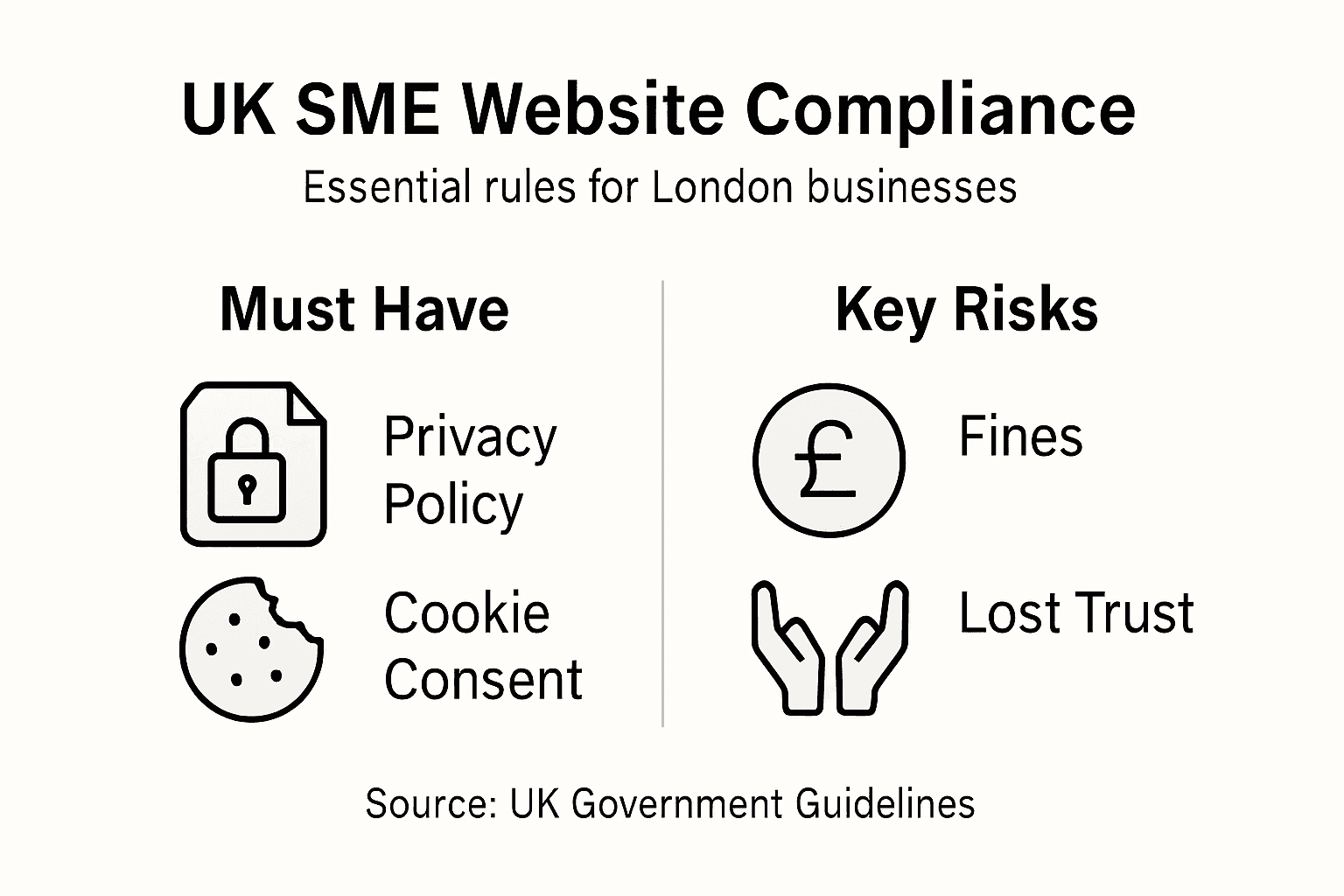
GDPR and data protection form the foundation of website compliance. Every time you collect customer information—whether through booking forms, email signups, or contact requests—you’re handling personal data and must comply with the Data Protection Act 2018. This means having a clear privacy policy explaining how you use customer information, obtaining explicit consent before collecting data, and allowing customers to access or delete their information. For aesthetics clinics collecting before-and-after photos or health information, this becomes particularly critical. UK regulations require transparent consent mechanisms and proper data security measures. You cannot simply state “we use cookies” buried at the bottom of your site; you must provide genuine choice and clear explanations. A restaurant collecting customer email addresses for marketing must make it obvious that customers are signing up for promotional content and allow them to opt out easily.
Web accessibility and transparency represent your second compliance priority. The Equality Act requires that your website remains accessible to people with disabilities, including those using screen readers or navigating with keyboards only. This isn’t optional and affects your restaurant or aesthetics clinic directly. Inaccessible websites can exclude customers and create legal liability. Additionally, the Electronic Commerce Directive requires business transparency: your website must clearly display your business name, address, contact information, and registration details. An aesthetics clinic must transparently show therapist qualifications. A restaurant must display accurate menu information and pricing. These requirements build customer trust and protect you legally. Understanding small business compliance obligations becomes increasingly important as regulations tighten through 2025 and beyond.
Cookie consent and marketing regulations complete your compliance checklist. You cannot track customer behaviour or run retargeting campaigns without explicit consent. When a visitor lands on your site, you must ask permission before dropping tracking cookies. This means implementing a genuine cookie banner that allows customers to accept or reject non-essential cookies, not a dark pattern that makes rejection difficult. Email marketing requires separate compliance under PECR regulations; you cannot email customers without permission or proper unsubscribe options.
Pro tip: Conduct a compliance audit of your website today: check whether your privacy policy exists and is clear, test your site with a screen reader to verify accessibility, and ensure your cookie banner allows easy rejection of non-essential tracking.
For quick reference, here is a summary of essential legal compliance elements for UK small business websites:
| Compliance Area | What Is Required | Risk If Ignored |
|---|---|---|
| GDPR/Data protection | Explicit consent, clear privacy | Fines, data breaches, loss of trust |
| Accessibility | Site usable by disabled visitors | Legal claims, lost customers |
| Transparency | Display business and contact info | Suspicion, potential regulatory fines |
| Cookie consent | Clear choice for cookies | Reputational damage, legal penalties |
Common Pitfalls and How to Avoid Them
Even well-intentioned London business owners make predictable mistakes with their websites that directly undermine growth. These aren’t technical failures; they’re strategic decisions that seem logical at the time but create friction for customers. Understanding the most common pitfalls helps you avoid wasting money on a website that looks professional but fails to convert visitors into bookings or sales. For restaurants and aesthetics clinics, these mistakes often cost thousands in lost revenue before anyone notices something is wrong.
The most damaging mistake is unclear messaging about benefits versus features. Your restaurant website might emphasise that you have “seating for 80 people” and “open kitchen,” but customers actually care about whether you have a relaxed family atmosphere or a romantic date night setting. An aesthetics clinic might highlight that it uses “state-of-the-art laser technology,” but customers want to know whether the treatment will reduce their acne scars or fine lines, and what the actual results look like. Focusing on customer benefits rather than technical features transforms your messaging from self-centred to customer-centred. Show before-and-after results. Explain how your food makes people feel. Demonstrate outcomes, not just offerings.
The second major pitfall is poor navigation and confusing website structure. Customers visiting your site shouldn’t need to hunt for booking buttons or contact information. A restaurant website should show reservations prominently on every page. An aesthetics clinic should make appointment booking visible without requiring customers to navigate through five menu layers. Many London businesses bury their most important actions (booking, contacting, purchasing) three or four clicks deep, forcing visitors to either leave frustrated or contact you by phone, which costs staff time. Simplify ruthlessly. Your primary customer action should be one click away from anywhere on your site. Additionally, avoid overly complex navigation menus that confuse visitors about what you actually offer. Clarity beats cleverness.
The third pitfall involves weak calls-to-action and unclear next steps. Visitors land on your site but don’t know what to do next. A vague “Contact Us” button is less effective than “Book Your Table Tonight” or “Book Your Free Consultation.” Weak copy like “Learn More” doesn’t inspire action; specific, benefit-driven text does. Your website should guide visitors through a clear journey: find you, understand what you offer, take action. Many websites get the first two right but fail on the third because calls-to-action lack specificity or urgency. Make every action crystal clear. Tell visitors exactly what happens when they click your booking button (“You’ll select your preferred time and receive instant confirmation”).
Pro tip: Record yourself visiting your website on a smartphone with fresh eyes, and time how many seconds it takes to find your booking option, view your best images, and understand your primary benefit. If it takes more than 10 seconds, your visitors are leaving.
Unlock Your London Business Growth with a Website That Works
The article highlights key challenges London SMEs face with their websites such as unclear booking paths, slow mobile performance, and weak SEO that hold back growth. If you want to move beyond a static online presence and instead build a website that drives bookings, builds trust, and generates measurable growth, it is essential to focus on the right digital infrastructure and marketing strategies. Whether your goal is clear calls-to-action, fast mobile loading, or integrated PPC and SEO campaigns, these elements are not luxuries but business essentials.
At Market Link Solutions, we specialise in helping London’s small businesses transform their websites into powerful growth engines. We combine expert web design and development with tailored PPC advertising and SEO optimisation to ensure your website becomes a central asset, not an expense. Don’t just take our word for it – see real-world results in our Success Stories Archives – Digital Marketing Agency – Market Link Solutions. Act now to secure your spot and create a website designed to convert your visitors into loyal customers. Visit us today to start your journey.
Frequently Asked Questions
What role does a website play in the growth of small and medium enterprises (SMEs)?
A website acts as a digital shop window, a conversion tool for turning visitors into customers, and provides essential infrastructure for business operations, enabling customer engagement and streamlining processes.
How can I optimise my website for better customer engagement?
To optimise your website, focus on speed, mobile responsiveness, clear booking or contact functionality, and showcase customer social proof through high-quality visuals and testimonials.
What are the key features that my business website should include?
Your website should prioritise features like fast loading times, mobile responsiveness, visible booking options, customer testimonials, clear calls-to-action, and SEO-optimised content targeting specific customer searches.
How can I ensure my website complies with legal requirements?
To comply with legal requirements, you must ensure GDPR compliance for data protection, maintain web accessibility, display transparent business information, and implement proper cookie consent mechanisms.