
A restaurant owner in London might wonder why their website sits quietly below bigger competitors on search results, even though the food and service are top notch. Visibility online depends heavily on how search engines position your website, a factor shaping whether new clients walk through your doors or book an appointment. Since Google Search covers over 90 percent of general search queries in the United Kingdom, understanding and improving your search engine ranking is crucial to reaching more local customers and staying ahead in your sector.
Table of Contents
- What Search Engine Ranking Means For Websites
- How Search Engines Decide Website Positions
- Key Ranking Factors For Local Businesses
- Improving Search Ranking In London Markets
- Common SEO Mistakes To Avoid Online
Key Takeaways
| Point | Details |
|---|---|
| Search Engine Ranking Is Crucial | Higher rankings improve visibility, traffic potential, and credibility for websites. |
| Key Ranking Factors | Content quality, user experience, and local relevance significantly impact search rankings. |
| Continuous Optimisation Is Necessary | Businesses must regularly update content and technical performance to maintain and enhance their rankings. |
| Avoid Common SEO Mistakes | Overloading keywords and neglecting mobile optimisation can severely hinder search visibility and performance. |
What Search Engine Ranking Means For Websites
Search engine ranking represents the precise positioning of a website within search engine results pages (SERPs), determining how easily potential customers can discover and access online content. For small businesses in London, understanding this concept is more than technical jargon – it’s a critical component of digital visibility and commercial success.
When it comes to online presence, search engine ranking functions like a digital storefront visibility index. Just as a restaurant’s location on a busy high street can attract more foot traffic, a website’s ranking influences its ability to attract digital visitors. Google Search covers over 90% of general search queries in the United Kingdom, making search ranking an essential metric for businesses.
Key aspects of search engine ranking include:
- Visibility: How prominently a website appears in search results
- Traffic potential: Number of potential visitors who might discover your site
- Credibility: Higher rankings suggest more authoritative and relevant content
- User accessibility: Improved discoverability for potential customers
Search rankings are dynamically calculated using complex algorithms that evaluate multiple factors. These include website content quality, user experience, mobile responsiveness, page loading speed, and relevance to search queries. Businesses that understand and optimize these elements can significantly improve their digital marketing performance.
Pro tip: Regularly audit your website’s technical performance and content relevance to maintain and improve your search engine ranking.
How Search Engines Decide Website Positions
Search engines employ sophisticated algorithms to determine website rankings, a process far more complex than many business owners realise. These intricate systems evaluate multiple factors to decide which websites appear most prominently in search results, essentially acting as digital gatekeepers for online visibility.
Search ranking algorithms prioritise multiple critical elements that collectively influence a website’s position. These sophisticated computational processes assess various aspects of digital content to determine relevance, credibility, and user value.
Key ranking factors include:
- Content Quality: Depth, relevance, and originality of website information
- User Experience: Website loading speed, mobile responsiveness, navigation ease
- Technical Performance: Site structure, security protocols, clean code
- Engagement Metrics: Time spent on site, bounce rate, user interactions
- Backlink Profile: Number and quality of external websites linking to your content
Search engines like Google continuously refine their algorithms to deliver the most relevant and valuable results. These dynamic systems analyse hundreds of signals to rank websites, ensuring that users receive the most appropriate and high-quality content for their search queries.

The competitive nature of search rankings means businesses must consistently optimise their digital presence. By understanding and adapting to these algorithmic requirements, London-based companies can improve their online visibility and attract more potential customers.
Pro tip: Regularly update your website content, improve technical performance, and focus on creating genuine value for your target audience to maintain strong search engine rankings.
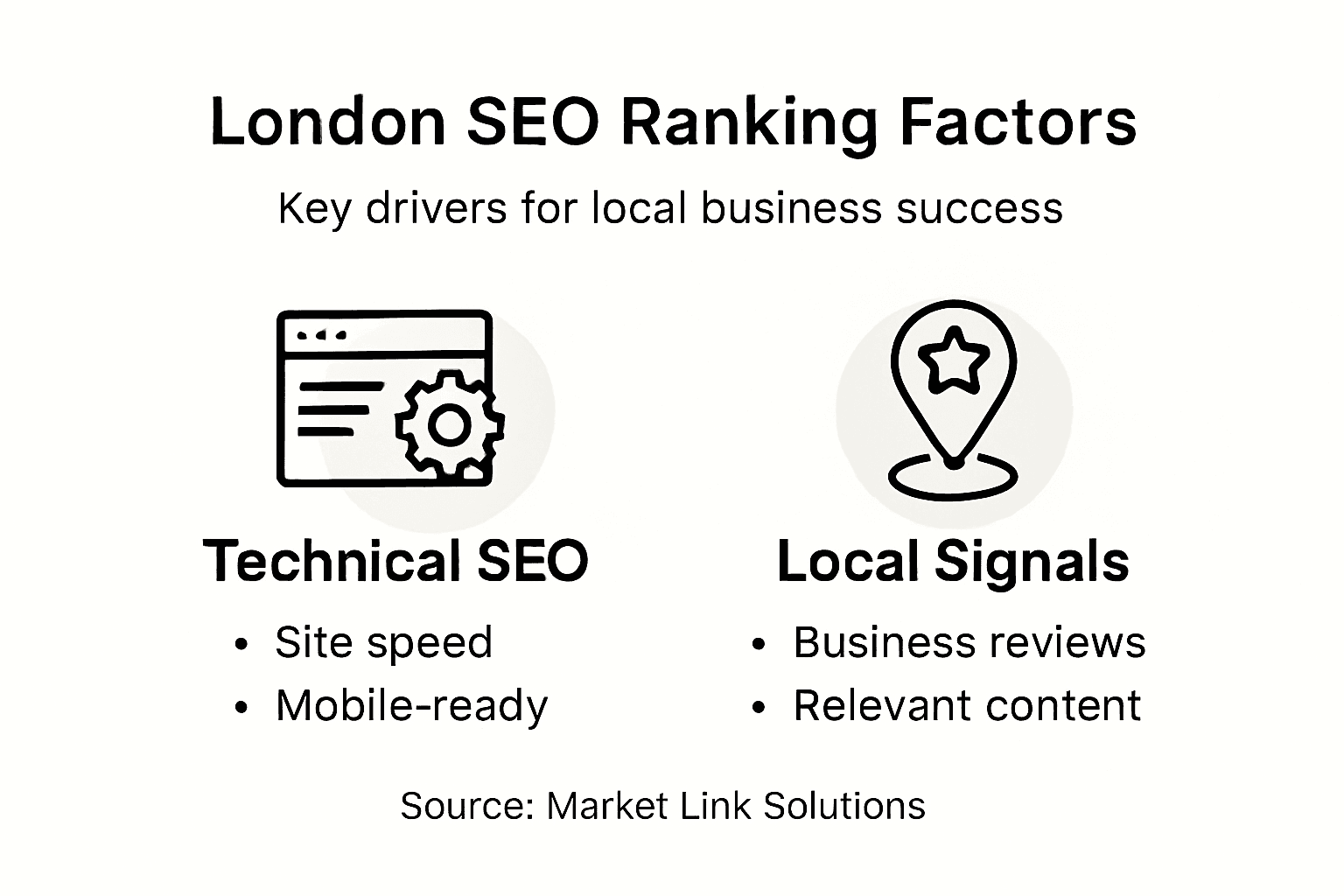
Key Ranking Factors For Local Businesses
Local businesses in London face a unique digital landscape where search engine rankings can make or break their online success. Digital adoption plays a critical role in small business growth, with search engine optimization becoming increasingly essential for attracting nearby customers.
The most crucial ranking factors for local businesses encompass a comprehensive digital strategy that goes beyond simple website existence. These elements work together to signal relevance, credibility, and value to search engine algorithms.
Key local SEO ranking factors include:
- Name, Address, Phone (NAP) Consistency: Ensuring accurate and uniform business information across all online platforms
- Google Business Profile: Complete, verified, and regularly updated business listing
- Local Reviews: Quantity, quality, and recency of customer feedback
- Website Localization: Content specifically tailored to London and surrounding areas
- Mobile Responsiveness: Seamless performance across mobile devices
- Location-Specific Keywords: Incorporating neighbourhood and city-specific search terms
Search engines prioritise businesses that demonstrate genuine local relevance and engagement. Technical performance and content quality remain fundamental to achieving higher rankings, with algorithms constantly evolving to reward authentic, user-focused digital experiences.
Small London businesses must view SEO as an ongoing process of refinement and adaptation. By understanding and implementing these ranking factors, local entrepreneurs can significantly improve their digital visibility and compete effectively in a crowded marketplace.
Pro tip: Invest time in creating locally relevant, high-quality content and actively manage your online reputation to boost your local search rankings.
Improving Search Ranking In London Markets
Improving search ranking in London’s competitive digital landscape requires a strategic and multi-faceted approach tailored to the city’s unique business ecosystem. London’s economic growth strategies increasingly emphasise digital engagement, making search engine optimization a critical component of business success.
Local businesses must develop a comprehensive digital strategy that goes beyond generic SEO techniques and focuses specifically on London’s dynamic market characteristics. Understanding the nuanced requirements of local search algorithms can provide significant competitive advantages for small and medium enterprises seeking to increase their online visibility.
Key strategies for improving search ranking include:
- Hyperlocal Content: Creating content specifically addressing London neighbourhoods and local interests
- Google Business Profile Optimization: Ensuring complete, accurate, and regularly updated business information
- Local Link Building: Developing relationships with other London-based businesses and websites
- Customer Review Management: Actively encouraging and responding to customer feedback
- Mobile-First Design: Ensuring seamless performance across mobile devices
- Location-Specific Keyword Targeting: Incorporating neighbourhood and city-specific search terms
Technical performance and targeted local content remain fundamental to achieving higher search rankings, with search engines consistently rewarding businesses that demonstrate genuine local relevance and engagement.
Here is a breakdown of how ranking improvement strategies differ for London-based businesses versus general UK approaches:
| Strategy Focus | London-Specific Tactics | General UK Tactics |
|---|---|---|
| Content Development | Hyperlocal narratives, London events | Broad topics, national interests |
| Keyword Targeting | Neighbourhood and borough terms | Generic business keywords |
| Link Building | Partnerships with London entities | Links from industry sites |
| Customer Engagement | Incentivising local reviews | Encouraging client testimonials |
| Business Listings | Detailed Google Business for each site | Single national listing |
Small London businesses must approach SEO as a continuous process of refinement, staying adaptable to changing digital landscapes and algorithm updates. By implementing these targeted strategies, local entrepreneurs can significantly enhance their digital presence and compete effectively in a crowded marketplace.
Pro tip: Invest consistently in creating high-quality, locally relevant content and maintain an active, updated online presence to improve your search engine rankings.
Common SEO Mistakes To Avoid Online
Search engine optimization requires strategic precision, and small London businesses frequently encounter critical errors that can dramatically undermine their digital visibility. Poor content management significantly impacts website indexing and search engine performance, making understanding these pitfalls crucial for online success.
Navigating the complex landscape of SEO demands meticulous attention to technical and content-related details. Many businesses unknowingly sabotage their search rankings through seemingly minor oversights that accumulate into substantial performance barriers.
Common SEO mistakes that London businesses must avoid include:
- Keyword Stuffing: Overloading content with repetitive keywords
- Neglecting Mobile Optimization: Failing to ensure responsive design
- Inconsistent Business Information: Misaligned details across online platforms
- Duplicate Content: Repeating identical or near-identical content
- Slow Website Performance: Poor loading speeds and technical inefficiencies
- Ignoring Local SEO Signals: Overlooking location-specific optimization strategies
Technical precision and strategic content development remain fundamental to avoiding SEO pitfalls, with search engines continuously evolving their evaluation methods to reward authentic, user-focused digital experiences.
Below is a summary of frequent SEO mistakes and their consequences for small London businesses:
| Mistake | Impact on Ranking | Typical Solution |
|---|---|---|
| Overusing keywords | Drop in credibility | Use natural keyword placement |
| Ignoring mobile users | Lost local visitors | Implement responsive design |
| Inconsistent details | Lower local visibility | Standardise NAP across sites |
| Duplicate content | Reduced search trust | Offer unique page material |
| Poor site speed | Visitor abandonment | Optimise images and code |
Successful SEO requires a holistic approach that balances technical performance, content quality, and strategic optimization. Small businesses must view search engine ranking as an ongoing process of refinement and adaptation, consistently monitoring and improving their digital presence.
Pro tip: Conduct monthly technical audits of your website and stay updated on the latest search engine algorithm changes to proactively address potential SEO challenges.
Boost Your London’s Business Search Ranking With Expert Support
Struggling to improve your website’s search engine ranking in London can feel overwhelming. The article highlights crucial challenges including local SEO nuances, technical performance, and content relevance that small businesses face daily to gain visibility and attract nearby customers. If you want to transform these challenges into growth opportunities, our London-based digital marketing agency specialises in tailored solutions like web design, SEO optimisation, and targeted PPC advertising that help your business stand out online.

Explore proven strategies and real results in our Success Stories Archives – Digital Marketing Agency – Market Link Solutions. Act now to secure a digital presence that drives genuine local engagement and grows your customer base. Visit Market Link Solutions today and take the next step towards mastering your local search rankings.
Frequently Asked Questions
What does search engine ranking mean for a website?
Search engine ranking refers to the position of a website in search engine results pages (SERPs), influencing how easily users can find and access your content online.
Why is search engine ranking important for small businesses?
Search engine ranking is crucial for small businesses as it directly affects visibility, website traffic, credibility, and user accessibility, which all contribute to commercial success.
How do search engines determine the ranking of a website?
Search engines use complex algorithms that evaluate factors like content quality, user experience, technical performance, engagement metrics, and backlink profiles to determine website rankings.
What are some common mistakes that can negatively impact SEO?
Common SEO mistakes include keyword stuffing, neglecting mobile optimisation, inconsistent business information, duplicate content, and slow website performance, all of which can harm search rankings.