
More than 80 percent of british businesses report that local SEO drives noticeable growth in their online presence. Standing out in a competitive city like London means targeting the search habits and interests of your local audience. By uncovering the most effective local keywords and following proven optimisation steps, you can put your business in front of the right customers and build genuine visibility right where it matters most.
Table of Contents
- Stage 1: Identify Target Keywords For Your Local Audience
- Stage 2: Optimise Website Structure For Search Engines
- Stage 3: Enhance On-Page Content With SEO Best Practices
- Stage 4: Build Local Links And Directories For Credibility
- Stage 5: Monitor Results And Adjust Your SEO Strategy
Quick Summary
| Key Insight | Explanation |
|---|---|
| 1. Focus on Local Keywords | Use specific local phrases like ‘emergency plumber in Hackney’ for better targeting and visibility. |
| 2. Optimize Website Structure | Ensure a clear navigation hierarchy to improve both user experience and search engine crawling. |
| 3. Craft High-Quality Content | Create informative, relevant content with primary keywords to attract and engage potential customers. |
| 4. Build Local Links | Register on reputable local directories and foster community connections to enhance credibility. |
| 5. Monitor and Adjust SEO | Regularly use analytics to review performance and adapt strategies based on insights for ongoing improvement. |
Stage 1: Identify target keywords for your local audience
Discovering the right local keywords is your strategic gateway to connecting with potential customers in London. By carefully selecting search terms that reflect your local audience’s specific interests and search behaviours, you can dramatically improve your website’s visibility and attract more targeted traffic.
Begin your keyword research by understanding your local market through comprehensive exploration. Local keyword research tools can help you uncover precise search queries specific to London businesses. For instance, rather than targeting generic terms like “plumber,” focus on hyper-local phrases such as “emergency plumber in Hackney” or “residential plumbing services Islington.” These localised keywords signal search engines that your content directly addresses neighbourhood specific needs.
When selecting keywords, prioritise terms with clear commercial intent that demonstrate a potential customer’s readiness to engage. Look for phrases combining service descriptions with location modifiers like “best digital marketing agency in Camden” or “affordable web design London.” Such targeted keywords not only improve your search rankings but also speak directly to customers seeking precisely what you offer.
One critical tip: always validate your keyword selections by checking their actual search volume and competition levels. Not all local keywords perform equally, so use keyword research tools to understand which terms genuinely attract potential customers in your specific London market segment.
Stage 2: Optimise website structure for search engines
Creating a search engine friendly website structure is crucial for improving your online visibility and helping potential customers find your London business quickly and easily. Your website’s architecture plays a pivotal role in how effectively search engines can crawl, understand, and rank your content.

Search engines rely on specific technical principles to index web pages, which means your website must have a clear, logical hierarchy. Start by designing an intuitive navigation system that allows both users and search engine crawlers to move seamlessly through your site. Implement a straightforward menu structure with descriptive category names that reflect your services and location. Organise your content into logical categories such as “Web Design Services,” “Digital Marketing London,” or “Local SEO Solutions” to help search engines understand your site’s purpose and relevance.
Each page should be strategically structured with a single primary keyword focus, using headers that clearly communicate the content’s purpose. Ensure your most important pages are no more than three clicks away from the homepage, creating a streamlined path that search engines can easily navigate. Pay special attention to internal linking create meaningful connections between related content that help users and search engine spiders understand the relationships between different pages on your site.
One critical tip create a sitemap that provides a comprehensive blueprint of your website’s structure. This XML file helps search engines quickly understand your site’s layout and ensures that all your valuable content gets properly indexed. By implementing these structural optimisations, you will significantly enhance your website’s search engine performance and increase the likelihood of ranking higher in local London search results.
Stage 3: Enhance on-page content with SEO best practices
Creating compelling on-page content that ranks well in search engines requires a strategic approach that balances user experience with technical optimisation. Your goal is to develop content that not only attracts potential customers but also signals relevance to search engine algorithms.
Start by crafting high-quality content that addresses user needs, focusing on informative and unique material that genuinely helps your London business audience. Use descriptive header tags in a logical hierarchy, ensuring each page has a clear H1 title that includes your primary keyword. Your subsequent headers H2 and H3 should break down content into digestible sections, naturally incorporating related keywords that reflect user search intent.
Meta descriptions play a crucial role in attracting click throughs from search results. Write concise compelling summaries that include your primary keyword and accurately represent the page content. Aim for descriptions between 150 and 160 characters that entice users to click while providing a clear value proposition. Incorporate location specific keywords for local London businesses to improve geographical relevance. Remember that while keywords are important, your primary focus should always be creating valuable content that genuinely helps your potential customers solve their problems or answer their questions.
One critical tip always prioritise readability and user experience over keyword stuffing. Search engines have sophisticated algorithms that recognise and penalise content that seems artificially manipulated. Your on page content should flow naturally, using keywords strategically and sparingly to maintain a conversational tone that engages your readers while subtly signalling relevance to search algorithms.
Stage 4: Build local links and directories for credibility
Building a robust network of local links and directory listings is essential for establishing your London business’s online credibility and improving your local search engine visibility. These strategic connections signal to search engines that your business is a legitimate and trusted local entity.
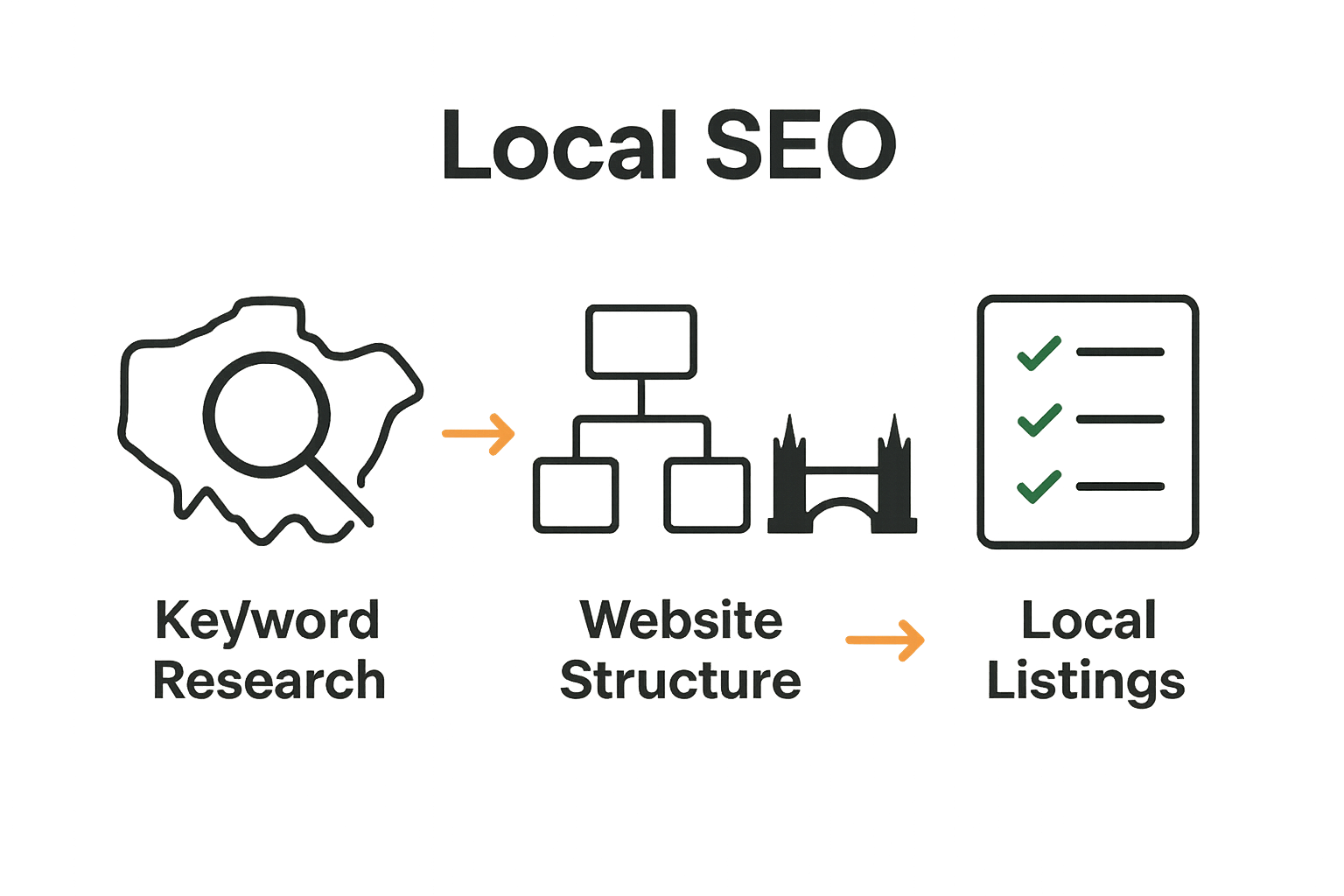
Local search strategies begin with identifying and registering on high quality business directories specific to London and your industry. Start with Google My Business, ensuring your profile is complete with accurate contact details, business hours, services, and high quality images. Explore industry specific directories like London Chamber of Commerce, professional associations, and local business networks that offer credible link opportunities. Focus on directories with strong domain authority and relevance to your specific business sector.
Expand your local link profile by engaging with the local community through strategic partnerships, sponsorships, and collaborative content. Consider creating valuable resources like local guides, neighbourhood business spotlights, or area specific blogs that attract natural backlinks from other local websites. Seek opportunities to contribute guest articles to local online publications, participate in community events, or offer expert insights that position your business as a trusted local authority.
One critical tip always prioritise quality over quantity when building local links. Search engines value genuine, relevant connections far more than numerous low quality directory listings. Focus on building meaningful relationships with reputable local organisations and websites that genuinely enhance your business’s local credibility and online reputation.
Stage 5: Monitor results and adjust your SEO strategy
Successfully implementing SEO requires ongoing measurement and strategic refinement. Your goal is to transform raw data into actionable insights that continuously improve your London business’s online performance and search engine visibility.
Advanced SEO tracking techniques involve using comprehensive analytics tools to understand how your website performs across multiple critical metrics. Start by setting up Google Analytics and Google Search Console to track key performance indicators such as organic traffic, keyword rankings, click through rates, and user engagement. Pay close attention to which pages attract the most visitors, which keywords drive meaningful traffic, and how users interact with your content. Look for patterns in user behaviour such as time spent on page, bounce rates, and conversion rates that indicate the effectiveness of your current SEO strategy.
Regularly review your website’s technical performance and content relevance. Conduct quarterly audits that examine your site speed, mobile responsiveness, internal linking structure, and content quality. Compare your performance against competitors in the London market and identify opportunities for improvement. Be prepared to adjust your keyword targeting, update outdated content, and refine your on page optimisation based on the insights you gather. Remember that SEO is an iterative process that requires constant learning and adaptation.
One critical tip approach SEO analytics with a holistic perspective. Do not get fixated on individual metrics but understand how they interconnect to tell a comprehensive story about your website’s performance. Small consistent improvements often yield more substantial long term results than sporadic major changes.
Take Your London Small Business SEO to the Next Level Today
If you are striving to master local SEO optimisation but feel overwhelmed by keyword research, website structure, and content strategies, you are not alone. Many small businesses in London encounter these exact challenges while aiming to boost their online visibility and attract more local customers. This practical guide highlights the importance of targeted keywords, savvy on-page content, technical website improvements, and credible local links — all critical areas where expert support can make a difference.
Discover how our London-based digital marketing agency helps small businesses like yours succeed with proven SEO optimisation, bespoke web design and focused PPC advertising. Check out our Success Stories Archives – Digital Marketing Agency – Market Link Solutions to see real examples of businesses transformed by our carefully tailored solutions. Don’t let your competitors take the lead. Visit https://market-link.co.uk now and let’s craft a personalised strategy that drives your growth from the heart of London.
Frequently Asked Questions
What are the best local keywords for my London-based business?
Start by researching terms that reflect your specific services and local area, such as “emergency plumber in Hackney” instead of just “plumber”. Focus on combining your service with a location to attract targeted traffic that is more likely to convert.
How can I optimise my website structure for search engines?
Create a clear and logical site hierarchy by designing an intuitive navigation system, ensuring vital pages are accessible within three clicks from the homepage. Use descriptive category names that are relevant to your services to help both users and search engines understand your content better.
What on-page SEO practices should I follow for my content?
Develop high-quality content that addresses your audience’s needs while incorporating relevant keywords naturally. Structure your content with clear headers (H1, H2, H3) to enhance readability and user experience, ensuring that your primary keyword is included in the title and meta descriptions.
How can I build local links to enhance my website’s credibility?
Focus on registering your business in high-quality local directories and engaging with the community through partnerships and guest articles. Create valuable local resources to attract backlinks from other relevant local websites, which can significantly improve your online authority.
What metrics should I track to measure my SEO performance?
Utilise analytics tools to monitor key performance indicators such as organic traffic, click-through rates, and user engagement. Regularly review these metrics and make adjustments to your SEO strategy, aiming to improve key metrics by at least 10% within the next quarter.
How often should I update my SEO strategy?
Adopt an iterative approach by regularly assessing your website’s performance every three to six months. Make adjustments based on user behaviour patterns and maintain your content’s relevance to ensure sustained improvement in your search visibility.
Recommended
- The Essential Guide to Role of SEO in Business
- Website Performance Guide – Digital Marketing Agency – Market Link Solutions
- Essential Guide to Local SEO London for Small Businesses
- Why SEO for Small Businesses: Complete Guide – Digital Marketing Agency – Market Link Solutions
- Unveiling London’s Perfume Culture: Your Scent Shopping Guide