
Every London restaurant or aesthetics clinic owner knows competition is fierce and customers expect to find you online in seconds. If new diners or clients are not discovering your business on the first page of Google, you risk missing out on valuable foot traffic. By focusing on local visibility and strategic SEO improvements, you can measure where you stand and map out the practical steps to rise up the search rankings, making it easier for local customers to choose you over someone else.
Table of Contents
- Step 1: Assess Current Website Health And Local Visibility
- Step 2: Identify Target Keywords For Local Search
- Step 3: Optimise Website Content And Structure For SEO
- Step 4: Build Local Citations And Gather Authentic Reviews
- Step 5: Verify Improvements With Analytics And Adjust Strategy
Quick Summary
| Main Insight | Detailed Explanation |
|---|---|
| 1. Assess Website Health | Use Google Search Console and PageSpeed Insights to evaluate SEO performance and loading speed. Understanding your current state is essential for improvement. |
| 2. Target Local Keywords | Identify specific search terms relevant to your services in London, ensuring they align with customer intent for better visibility. |
| 3. Optimise Content Structure | Improve page titles, headings, and meta descriptions to enhance click-through rates and SEO effectiveness across your site. |
| 4. Build Local Citations | Claim your Google Business Profile and ensure consistent citations on local directories to establish your business’s legitimacy and visibility. |
| 5. Monitor Progress Regularly | Set up Google Analytics to track visitors, keyword rankings, and conversions; adapt strategies based on data to refine SEO efforts. |
Step 1: Assess current website health and local visibility
Your website is often the first impression potential customers get of your restaurant or aesthetics clinic. Before you can improve your SEO performance, you need to understand exactly where you stand right now. This step involves examining both the technical side of your website and how visible you currently are to local customers searching for businesses like yours in London. Think of it like checking your pulse before starting a fitness programme, it tells you what baseline you’re working from.
Start by using Google Search Console, which is completely free and gives you direct insight into how Google sees your site. Sign in with your Google account, add your website if you haven’t already, and look at the Performance tab. This shows you which keywords people are actually using to find your business, how many times your site appears in search results, and what your average ranking position is. Pay attention to queries that show high impressions but low click through rates, these suggest your current listings aren’t compelling enough to make people click. For your restaurant or clinic, look specifically for local searches like “best restaurants near me in London” or “aesthetics clinic in South London” to see where you rank for these crucial local terms.
Next, run your website through Google PageSpeed Insights. Enter your website URL and Google will grade both your mobile and desktop performance. This matters enormously because Google prioritises fast loading sites, and most of your potential customers are browsing on their phones whilst looking for dinner reservations or clinic appointments. A slow site is a lost customer. If your score is below 50, you have serious work to do. Look at the specific recommendations, whether it’s image optimisation, javascript that’s slowing things down, or server response times. Many of these fixes are technical but your web developer or a digital agency can address them quickly.
Check your local search presence by searching for your business name directly on Google. Do you have a Google Business Profile? This is absolutely non-negotiable for local visibility. If you don’t have one, create it immediately. If you do have one, claim it properly and make sure all information is accurate and up to date. Your address, phone number, website URL, and business category must be perfect. Incorrect or incomplete information is like putting the wrong address on your storefront, customers literally cannot find you. Reviews on this profile directly influence your local rankings, so having positive reviews is part of good SEO health.
Analyse your current backlinks using a free tool like Ubersuggest or Ahrefs free version. Backlinks are links from other websites pointing to yours, and they act like votes of confidence for your site’s authority. For a London restaurant or aesthetics clinic, local backlinks from local review sites, the Chamber of Commerce, local business directories, or local food and beauty publications carry more weight than random links from anywhere. You’re looking for quality over quantity, not hundreds of poor quality links.
Finally, assess your on page SEO basics by examining your top pages. Do they have clear, descriptive titles that include your location and service? Does each page have a proper meta description that shows up in search results and tells people what to expect? Are your headings structured logically? If someone searches for “restaurant near Canary Wharf” or “aesthetic treatments in Mayfair”, would your pages be optimised to show up? Understanding how technical SEO impacts local visibility will give you deeper insight into what’s working and what needs fixing in your current setup.
Collect all these findings in a simple spreadsheet. Document your current rankings for important local keywords, your PageSpeed scores, the number of reviews you have, your backlink count, and any technical issues you’ve identified. This becomes your baseline. You’ll refer back to this in coming months to measure how much progress you’re making with your SEO efforts. Without knowing where you started, you can’t celebrate how far you’ve come.
Here is a quick reference for essential website health metrics and their business impact:
| Metric | What It Measures | Why It Matters |
|---|---|---|
| PageSpeed Score | Loading speed on mobile/desktop | Fast sites boost SEO and reduce customer drop-offs |
| Local Keyword Rankings | Visibility for key search terms | Higher ranks lead to more footfall and attention |
| Backlink Quantity | Number of external sites linking to you | Quality backlinks signal authority and trust |
| Google Reviews Count | Customer review volume on Google Profile | More positive reviews improve local search ranking |
| NAP Consistency | Accuracy of business name, address, phone | Ensures business is easily found and trusted |
Pro tip Take screenshots of your current Google Search Console performance and Google Business Profile stats right now, dated with today’s date. These screenshots become proof of your starting point and make your future wins look far more impressive when you can show the before and after side by side.
Step 2: Identify target keywords for local search
Keywords are the bridge between what your potential customers are searching for and your restaurant or aesthetics clinic. Without the right keywords, your perfectly optimised website might as well be invisible. This step is about uncovering exactly which search terms your London customers are typing into Google when they want what you offer. You are not looking for vanity keywords that sound nice, you are hunting for the specific phrases that turn searchers into customers.
Start by thinking like your customer. If you run a restaurant in Shoreditch, your ideal customers are not searching for “fine dining establishment” they are searching for “best Italian restaurants near me” or “where to eat in Shoreditch tonight”. If you own an aesthetics clinic in Knightsbridge, people search for “botox clinic near me” or “anti-wrinkle treatments Knightsbridge”, not generic terms like “cosmetic services”. Write down 10 to 15 phrases that come naturally to you. Include your location name, your specific services, and variations that reflect how real people talk. This brainstorm list becomes your foundation.
Now validate your ideas using Google itself. Type each phrase into the search bar and pay attention to what Google suggests. Those dropdown suggestions are gold because they show real searches people are actually making. Type “best restaurants in” and Google will suggest places, times, and cuisines. Type “aesthetics near” and it will suggest specific treatments and areas. Make a note of these suggestions as they confirm what your customers are genuinely looking for. Look at the search results pages too. What websites rank at the top? Are they Google Maps results? Big review sites? Local business directories? This tells you what type of content Google thinks answers that query best.
Use a free keyword research tool to dig deeper. Google Keyword Planner, which is free if you have a Google Ads account, shows you monthly search volumes for your keywords. This helps you prioritise. A keyword that gets 500 searches a month is worth more effort than one with only 50. Ubersuggest also offers free searches and shows you search volume plus competition level. You want keywords with decent search volume but not overwhelming competition. For local businesses, geo targeted keywords with location names increase relevance in local searches, so always include your borough, postcode area, or London district. “Best restaurants Fitzrovia” will outperform “best restaurants” for a Fitzrovia restaurant because it matches local intent exactly.
Analyse your competition by looking at the websites currently ranking for your chosen keywords. Visit their pages and ask yourself what keywords they are targeting. What words appear in their page titles? What do they mention in their introductory paragraphs? Use free tools like MozBar to see what keywords competitors are ranking for. Do not copy them verbatim but use this research to understand the keyword landscape. You might discover variations you had not considered. You might also find gaps where competitors are not covering certain keywords, and those gaps become your opportunities.
Align your keywords with what you actually offer and what customers want. If you are a fine dining restaurant, targeting “cheap eats near me” wastes time. If you offer specialist aesthetics treatments, chasing generic “beauty clinic” searches misses the mark. Aligning keyword research with user intent means ensuring all target keywords reflect local user search patterns in your area. A customer typing “vegan restaurant Hackney” has clear intent, they want exactly what you offer. That is a keyword worth chasing. Create a final list of 15 to 25 keywords that balance search volume, competition level, and realistic relevance to your business.
Organise your keywords by page. Your homepage should target your most important keywords like your business name plus location. Your services page should target mid tier keywords for each treatment or cuisine type you offer. Individual blog posts or service pages can target longer, more specific keyword phrases. This structure prevents you from competing against yourself and ensures each page has a clear SEO purpose. Document everything in a spreadsheet with columns for keyword, estimated monthly searches, competition level, and which page targets it. This keyword map becomes your SEO roadmap for the coming months.
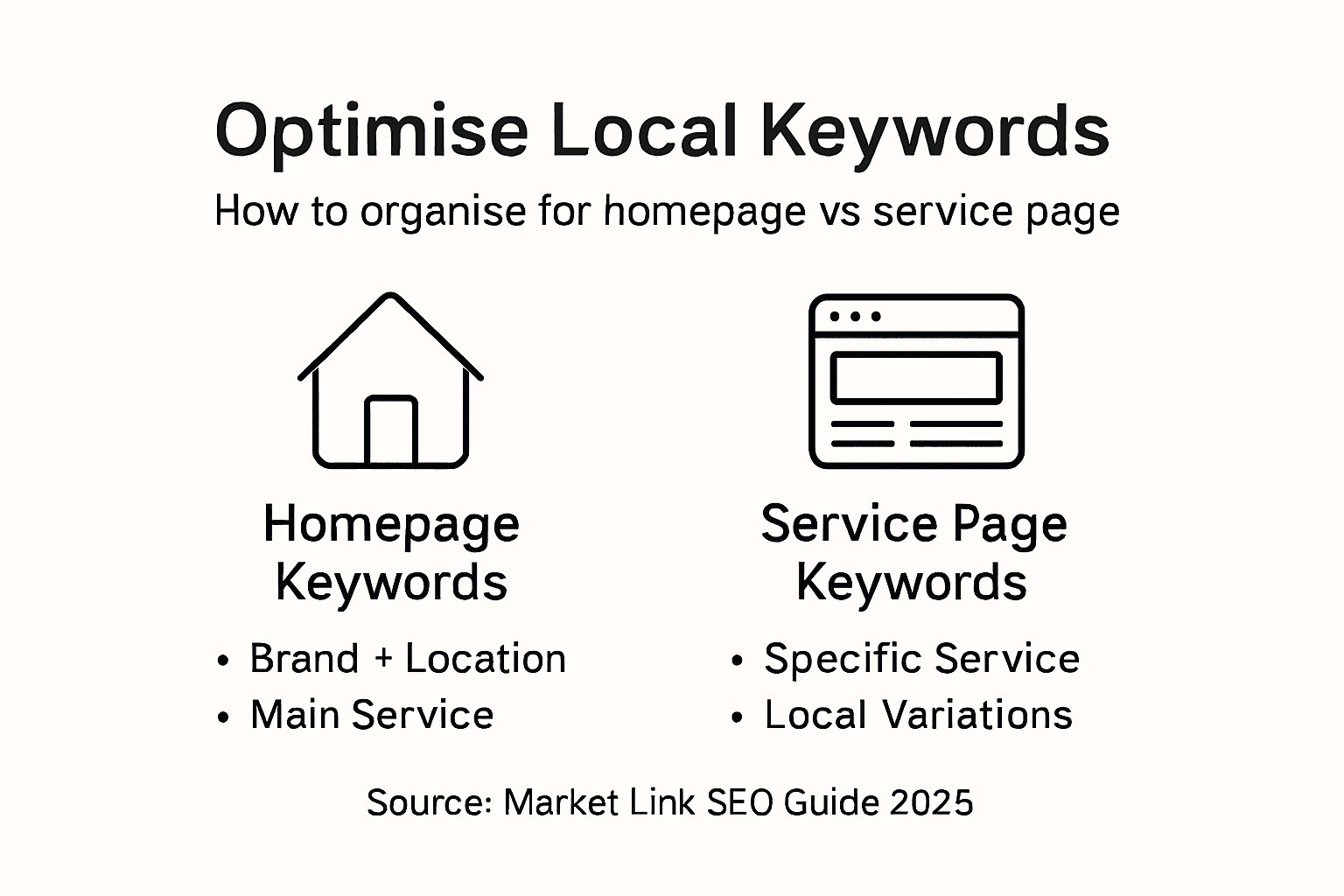
Pro tip Search for your target keywords on Google Maps alongside the main search results. If your keyword triggers a Maps pack with three local businesses, that keyword is hot for local search. Prioritise keywords that show strong local intent because these are the ones that will actually drive customers through your door.
Step 3: Optimise website content and structure for SEO
You now know what your customers are searching for and where your website currently stands. The real work begins here: transforming your website into something Google rewards with higher rankings. This step involves restructuring how your content is organised and making sure every page is optimised for both search engines and the people reading it. Think of it as giving your website a proper foundation so it can grow upwards.
Start with your page titles and meta descriptions. These are the first things searchers see in Google results, and they heavily influence whether someone clicks through to your site. Your page title should include your target keyword plus your location and business type. Instead of “Menu”, try “Italian Restaurant in Shoreditch, London” or “Award Winning Italian Dining Fitzrovia”. Your meta description is the snippet beneath your title, and it should be between 150 to 160 characters that compel people to click. Describe what makes your business unique and include your location. For an aesthetics clinic, rather than generic text, write something like “Specialist aesthetic clinic in Knightsbridge offering anti-wrinkle treatments and skin rejuvenation with proven results”. These small changes make a massive difference in your click through rate.

Now examine your heading structure. Every page should have exactly one H1 heading that reflects your main keyword. Subheadings should use H2 and H3 tags and should be structured logically. If you are writing about your restaurant’s private dining options, your structure might be H1 for “Private Dining at our Fitzrovia Restaurant”, then H2 headings for “Bespoke Menus”, “Intimate Spaces”, and “Event Packages”. This logical hierarchy helps Google understand your content and helps readers scan your page quickly. Avoid keyword stuffing, which means cramming keywords unnaturally into headings. Write for humans first, search engines second.
Ensure your internal linking strategy is strong. User-friendly internal linking improves navigation and SEO performance across your entire site. If you have a blog post about “Tips for Choosing an Aesthetics Clinic”, link to your main services page from relevant phrases. If you have a restaurant page about your wine selection, link to it from your dining experience page. These internal links distribute authority throughout your site and help Google crawl and index all your important pages. Every page on your site should be linked to from at least one other page. Dead end pages that nobody links to are invisible to Google.
Optimise your content depth and relevance. Short, thin pages do not rank well. If you are writing about “Botox Treatments in London”, do not stop at 200 words. Cover what botox actually is, how it works, expected results, how long they last, costs, aftercare, and common questions. Aim for at least 1000 words for important service pages. People searching for information want comprehensive answers, and Google rewards pages that provide genuine value. But avoid padding with fluff. Every sentence should serve a purpose and relate to your topic.
Create user friendly URLs that describe what the page is about. Instead of “example.com/page123” use “example.com/aesthetics-clinic-knightsbridge” or “example.com/italian-restaurant-shoreditch”. Include your target keyword in the URL when possible, but keep it concise. URLs are part of your SEO profile and they should be readable both by humans and search engines. Once your URLs are set, do not change them without proper 301 redirects because broken links damage your SEO.
Make certain your website is mobile-friendly with fast loading speeds. Most of your customers will visit on their phones, and Google ranks mobile responsiveness as a ranking factor. Your images should be optimised for size so they load quickly. Compress images before uploading them. Minify your CSS and JavaScript. Your server response time matters. If your PageSpeed Insights score from Step 1 was below 50, prioritise fixing these technical issues now because a slow site loses customers and loses rankings.
Organise your content by customer journey. Your homepage should welcome visitors and guide them to key services. Your services pages should explain what you offer in detail with your target keywords naturally woven in. Your about page should build trust. Your contact page should make it easy to reach you. Your blog should answer questions your customers actually ask. This logical structure helps both Google and your customers understand your business.
Pro tip Audit your current pages and create a content map showing which keywords each page targets, what headings it uses, and what other pages link to it. This visual map becomes your blueprint for improvement and helps you spot gaps where you are missing keyword coverage or have pages that nobody links to.
Step 4: Build local citations and gather authentic reviews
Local citations and customer reviews are like having thousands of people vouching for your business across London. A citation is simply a mention of your business name, address, and phone number on reputable websites and directories. Reviews are what customers say about their experience with you. Together, they form a powerful trust signal that tells Google your business is real, legitimate, and worth ranking higher. This step transforms you from an unknown website into a trusted local authority in your industry.
Start by claiming and optimising your Google Business Profile if you have not done so already. This is your primary citation and the most important one. Make sure your business name is exactly as registered, your address is precise with the correct postcode, and your phone number is accurate. Upload high-quality photos of your restaurant dining area or your aesthetics clinic treatment rooms. Customers want to see what they are getting into before they visit. Write a compelling business description that includes your key services and location. Verify your address through Google’s verification process, which typically involves receiving a postcard to confirm you operate from that location.
Next, build citations across reputable UK business directories. Building citations across directories like Yell, Thomson Local, and similar platforms establishes consistent NAP information that Google uses to verify your business legitimacy. Create accounts on these major directories and enter your information carefully. The most critical rule is consistency. Your business name must be identical everywhere. Your address must match exactly. Your phone number cannot vary. Google uses these citations as verification that your business is real. If one directory says you are at “123 High Street” and another says “123 High St”, Google gets confused about which is correct. Use the full spelling everywhere or the abbreviation everywhere, but be consistent. Create a spreadsheet documenting every directory where you appear, the citation quality, and whether the NAP data is correct.
Now focus on gathering authentic customer reviews. Encourage your existing customers to leave reviews on Google, Trustpilot, and Facebook. The easiest approach is to ask directly. After a customer has eaten at your restaurant or completed their treatment at your clinic, follow up with a simple message saying “We would love to hear about your experience. Would you mind leaving a Google review?” Include a direct link to your Google Business Profile review page, which makes it one click away. Do not offer incentives to leave positive reviews only, this violates review platform policies and damages your credibility if discovered. Instead, genuinely provide excellent service so people naturally want to leave positive feedback.
Manage reviews actively, not passively. Respond to every review, both positive and negative. When someone leaves a five star review saying “Best Italian restaurant in Fitzrovia”, reply with something genuine like “Thank you so much for the kind words. We hope to see you again soon.” When someone leaves a critical review, resist the urge to be defensive. Instead, acknowledge their concern, apologise for their negative experience, and offer to make it right. Respond within 48 hours if possible. This shows potential customers that you actually care about feedback and that you are an engaged business owner. Negative reviews handled well often convert into positive word of mouth because people respect businesses that address concerns professionally.
Build citations beyond just directories by getting mentioned on relevant local websites. If you are a restaurant, reach out to local food bloggers or request to be listed on local food guides. If you are an aesthetics clinic, connect with local beauty publications or wellness sites. These citations carry extra weight because they come from contextually relevant sources. Join your local Chamber of Commerce and get listed there. Sponsor a local charity or school event and get mentioned on their website. Participate in community activities and ask if you can be featured in local news coverage. Each genuine citation from a reputable local source adds credibility to your business.
Document your review strategy. Set a monthly target for new reviews. Aim for at least two to three reviews per month from genuine customers. Track which platforms are generating the most reviews and which types of customers are most likely to leave feedback. You will notice patterns. Perhaps customers who spend more money are more likely to review, or customers who have had exceptional service. Use these insights to intentionally deliver remarkable experiences that generate reviews organically. Remember that reviews are not just for SEO. They provide valuable feedback about what your customers actually think. A string of reviews mentioning “slow service” is telling you to improve your operations. A pattern of praise for specific dishes means you should feature them more prominently.
The following table summarises key platforms for building local citations in the UK:
| Directory/Platform | Type of Citation | Unique Benefit |
|---|---|---|
| Google Business Profile | Primary/Verified | Direct impact on Google Maps visibility |
| Yell | Business Directory | Trusted UK source, strong local SEO |
| Thomson Local | Business Directory | Reliable info for UK searchers |
| Trustpilot | Customer Reviews | Enhances reputation with credible reviews |
| Local Chamber of Commerce | Authority Directory | Builds industry trust and community profile |
| Local Food/Beauty Blogs | Contextual Citation | Highly relevant backlinks and referral traffic |
Pro tip Create a simple system where your staff asks every customer for a review before they leave or immediately after their visit. Place a QR code on receipts that links directly to your Google review page. Many restaurants place review request cards on tables. Aesthetics clinics can send SMS or email reminders 24 hours after an appointment with a link to leave a review. The more friction you remove from the review process, the more reviews you will collect.
Step 5: Verify improvements with analytics and adjust strategy
You have made significant changes to your website, built citations, gathered reviews, and optimised your content. Now comes the part that separates serious business owners from those who just hope for results: measuring what actually happened. This step involves tracking your progress using analytics tools and adjusting your strategy based on real data. You will discover what is working brilliantly, what needs tweaking, and what to abandon entirely.
Start by setting up Google Analytics 4 if you have not already done so. This free tool tracks every visitor to your website. Look at the Acquisition section to see how many visitors came from organic search versus other sources like direct traffic or social media. Your goal is to increase organic search traffic month over month. Compare your current numbers to the baseline you documented in Step 1. If you had 150 organic visitors per month three months ago and now have 280, your SEO efforts are working. If the number has not moved or has declined, something needs to change. Track not just visitor count but also which pages are attracting the most traffic and which are receiving none. Pages that attract no organic traffic are either not ranking for anything or ranking so poorly that nobody clicks through.
Monitor your keyword rankings using a tool like Google Search Console or a more comprehensive platform. Tracking keyword rankings and site health metrics reveals whether SEO improvements are delivering measurable results over time. In Google Search Console, look at the Performance report monthly. Which keywords are you ranking for? What position are you ranking at? Are certain keywords climbing higher month after month? A keyword you ranked 45th for three months ago that now ranks 22nd is progress worth celebrating. Focus your efforts on keywords that are showing upward movement. Keywords stuck in positions 40 to 50 are essentially invisible to customers, but keywords in positions 5 to 10 get clicked regularly. Invest more effort into the keywords showing momentum.
Track your click through rate by looking at how many people search for you and actually click your listing. A high impression count with a low click through rate tells you your page title or meta description is not compelling enough. People see you in search results but choose competitors instead. In this case, rewrite your meta descriptions to be more persuasive and include a clear benefit or call to action. A low impression count means you are not ranking for enough keywords or your rankings are too low to appear in most searches. This means you need more content targeting additional keyword variations or deeper optimisation of your existing pages.
Monitor your local search visibility using Google My Business insights. How many people are searching for your business by name? How many people are finding you through local searches? How many people are clicking to call you or visit your website? How many people are leaving reviews? These metrics reveal how visible you are becoming in your local area. If calls are increasing but website visits are not, your local citations and reviews are working but your website needs optimisation. If website visits are increasing but calls are flat, you may need to make your phone number more prominent or your location easier to understand.
Examine your website behaviour using analytics. What is your bounce rate on important pages? Bounce rate is the percentage of visitors who leave after viewing only one page. A high bounce rate on your services page suggests the content is not meeting expectations or the page is poorly structured. Are people spending time reading your content or are they leaving immediately? Time on page indicates engagement. If visitors spend only 5 seconds on your blog post about restaurant services, the content is not resonating. If they spend 2 minutes, you have their attention. Look at conversion data if you have set it up. How many visitors are completing your goals, whether that is booking a reservation, scheduling a consultation, or filling out a contact form? This is what ultimately matters. More traffic means nothing if nobody converts into a customer.
Adjust your strategy quarterly based on what you learn. If certain blog topics are attracting high traffic and leading to conversions, create more content like that. If a keyword is climbing and driving traffic, optimise related pages to capture additional variations. If certain pages have high traffic but low conversions, test different layouts, clearer calls to action, or additional content addressing customer concerns. Continuous monitoring of analytics allows you to refine your SEO strategy based on actual performance data rather than assumptions. Do not change everything at once because you will not know what caused the improvement. Make one change, wait a month, measure the impact, then decide whether to keep it or try something different.
Document your findings in a simple monthly report. Record your organic traffic, keyword rankings for your top ten keywords, your click through rate, your page one rankings, and your conversion numbers. Over six months, you will see clear patterns. Maybe your summer traffic dips because restaurants are less busy as people eat outdoors, but your spring traffic spikes. Maybe your aesthetics clinic sees a surge in searches in January because people make new year resolutions about appearance. Understanding these patterns helps you plan your marketing calendar and allocate budget more strategically.
Pro tip Set up automated email reports so key metrics come to your inbox weekly. This keeps SEO progress visible to you without requiring you to log in and check manually. Most analytics platforms offer this feature. When you see organic traffic climbing consistently, it reinforces that your work is paying off and keeps you motivated to maintain the effort.
Elevate Your London Business with Expert SEO and Digital Marketing Support
Navigating the complexities of SEO optimisation for small businesses in London can feel overwhelming. From analysing website health and targeting the right local keywords to building authentic reviews and tracking progress, each step demands time and specialist knowledge. If you are striving to boost your local visibility, improve search rankings, and attract more customers through search engines, you are not alone.
At Market Link Solutions, we understand the unique challenges faced by London-based small businesses. Our tailored services, including web design and development, PPC advertising on Google and Instagram, and dedicated SEO optimisation, are built to help you conquer these hurdles efficiently. Discover how others have achieved remarkable growth by exploring our Success Stories Archives – Digital Marketing Agency – Market Link Solutions.
Take control of your online presence today by partnering with a local agency that knows your market. Visit Market Link Solutions to start transforming your SEO strategy into measurable success. Your journey to higher rankings and increased customer engagement begins now.
Frequently Asked Questions
How can I assess the current health of my website for SEO?
To assess your website’s current health, use Google Search Console to check your performance metrics such as keyword rankings and click-through rates. Start by signing in and reviewing the Performance tab to identify areas needing improvement, especially for local searches relevant to your business.
What are local keywords and why are they important for my business?
Local keywords are specific phrases that potential customers use when searching for services in their vicinity, such as “best restaurant near me” or “aesthetics clinic in South London”. Identifying and using these keywords effectively can help improve your visibility and attract more local customers to your business.
How should I organise my website content for optimal SEO?
Organise your website content by clearly defining Page Titles and Meta Descriptions that include relevant keywords and your location. Structure headings logically with one H1 for each page, followed by H2s and H3s to enhance readability and SEO effectiveness.
What steps can I take to improve my local citations and reviews?
To improve local citations and reviews, claim your Google Business Profile, ensure your NAP (Name, Address, Phone number) information is accurate, and actively encourage satisfied customers to leave reviews. Set a target of gathering two to three new reviews each month to build credibility and enhance local search rankings.
How can I measure the effectiveness of my SEO strategies over time?
Measure the effectiveness of your SEO strategies by using Google Analytics to track organic traffic, keyword rankings, and conversion rates. Review this data quarterly to identify trends and areas needing adjustment, aiming for continuous improvement based on measurable insights.
What should I do if my website’s bounce rate is high?
If your website’s bounce rate is high, this indicates visitors are leaving quickly without engaging with your content. Consider revising your page content to be more relevant and engaging, aiming to increase user time on page by providing valuable information that addresses search intent.