
Trying to navigate SEO conversations can leave even London restaurant owners and clinic managers feeling lost in technical jargon. Grasping terms like keywords, organic traffic, or Google My Business is not just about staying current, it is a direct path to reaching local customers who are actively searching for your services. This article makes sense of the most important SEO terminology so you can approach digital marketing with confidence and spot real opportunities for growth in the London market.
Table of Contents
- Defining SEO Terminology For London Business
- Categories Of SEO Terms And Concepts
- On-Page, Off-Page, And Technical Distinctions
- Core Terms For Local Restaurants And Clinics
- Mistakes And Misconceptions To Avoid
Key Takeaways
| Point | Details |
|---|---|
| Understanding SEO | SEO enhances online visibility for London businesses through strategic improvements in website performance and local targeting. |
| Key Categories of SEO | Focus on Technical, On-Page, Off-Page, and Local SEO for comprehensive online presence optimisation. |
| Importance of Local SEO | Geo-targeted keywords and Google My Business optimisation are essential for attracting nearby customers. |
| Avoid Common Mistakes | Keyword stuffing, black hat techniques, and neglecting mobile optimisation can severely damage SEO performance and credibility. |
Defining SEO Terminology for London Business
Search Engine Optimisation (SEO) represents a complex digital strategy that helps London businesses enhance their online visibility and attract potential customers through strategic website improvements. While many entrepreneurs recognise SEO as important, understanding its specific terminology can feel overwhelming. The SEO principles for local businesses require breaking down complex concepts into digestible insights.
At its core, SEO involves several key elements that work together to improve a website’s performance in search engine rankings. Keywords represent specific terms potential customers might use when searching for products or services. These strategic words must align closely with your business offerings and local London market needs. Organic traffic refers to visitors who arrive at your website through unpaid search results – essentially customers who find you naturally through Google without advertising spend.
Local SEO becomes particularly crucial for London-based businesses seeking to attract nearby customers. This specialised approach focuses on optimising your online presence for geographically targeted searches. Techniques include claiming your Google Business Profile, ensuring consistent business name and address information across online platforms, and generating location-specific content that resonates with London audiences.
Pro tip: Start tracking your website’s keyword rankings and organic traffic using free tools like Google Search Console to understand your current SEO performance and identify improvement opportunities.
Categories of SEO Terms and Concepts
SEO terminology can be broadly categorised into several interconnected domains that work together to improve a website’s online performance. These categories help London businesses understand the multifaceted approach required to enhance digital visibility. Content strategies play a critical role in determining how effectively a website communicates with both search engines and potential customers.
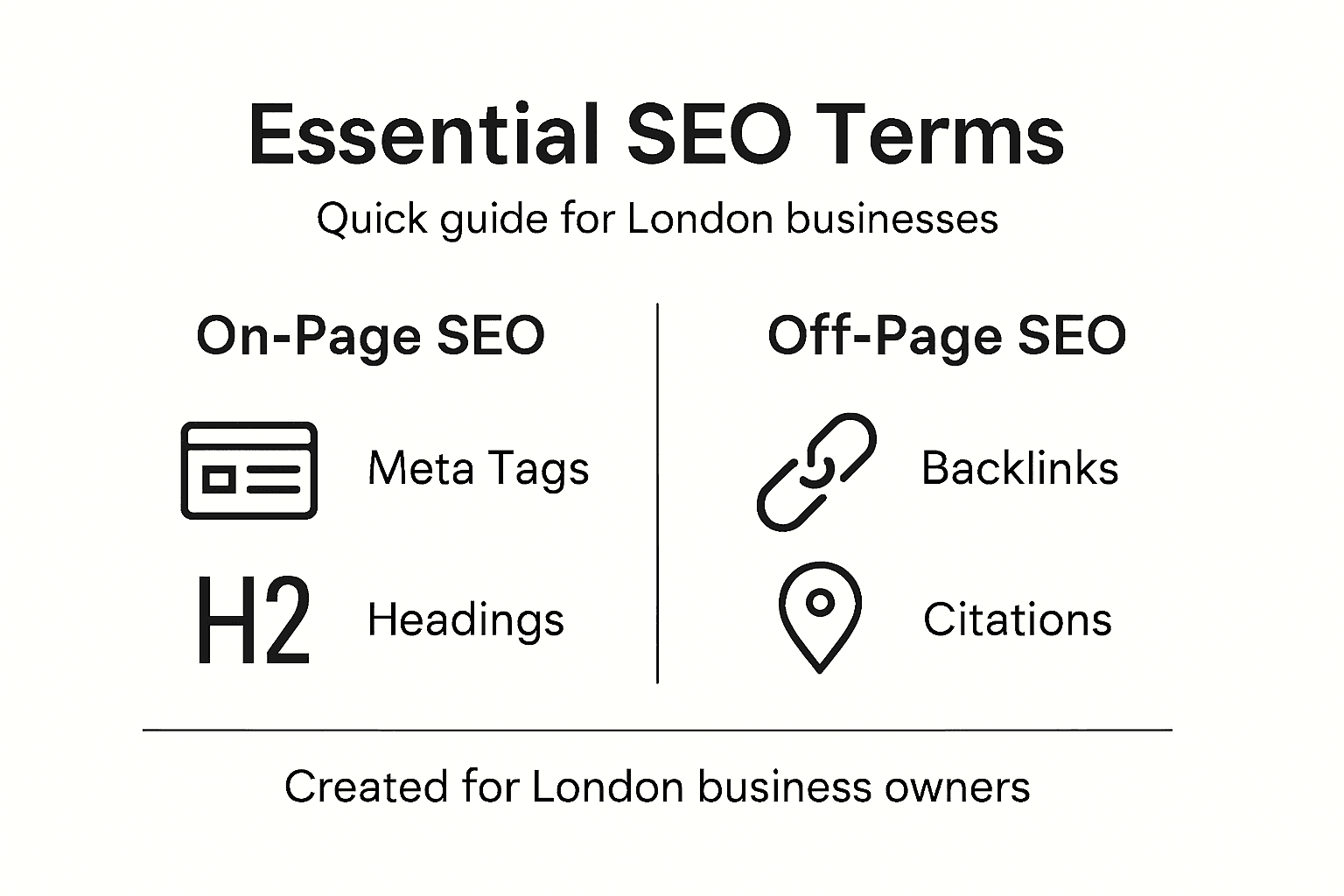
The primary categories of SEO terms include Technical SEO, which focuses on website infrastructure and performance metrics. This encompasses site speed, mobile responsiveness, crawlability, and structured data implementation. On-Page SEO relates directly to content elements such as keyword optimisation, meta descriptions, header tags, and internal linking strategies. These elements help search engines understand the context and relevance of your web pages.
Off-Page SEO represents external factors that influence your website’s authority and credibility. This category includes backlink strategies, social media signals, and online reputation management. For London businesses, Local SEO becomes particularly crucial, involving location-specific optimisation techniques like Google Business Profile management, local keyword targeting, and generating location-based content that attracts nearby customers.
Pro tip: Create a spreadsheet to track your SEO performance across these different categories, monitoring key metrics and identifying areas for systematic improvement.
Here is a concise comparison of the main SEO categories and their business significance:
| SEO Category | Main Focus | Typical Techniques | Business Benefit |
|---|---|---|---|
| Technical SEO | Website structure and performance | Speed, mobile optimisation, HTTPS | Improved indexability and ranking |
| On-Page SEO | Page content and keywords | Headings, meta descriptions, linking | Better relevance, higher traffic |
| Off-Page SEO | Authority and trust signals | Link-building, social shares | Enhanced domain credibility |
| Local SEO | Location-based visibility | Google Business Profile, reviews | Attracts nearby customers |
On-Page, Off-Page, and Technical Distinctions
Understanding the nuanced differences between on-page, off-page, and technical SEO is crucial for London businesses seeking to improve their digital presence. Technical SEO principles form the foundational infrastructure that enables search engines to effectively crawl, understand, and rank website content.
On-Page SEO involves direct optimisation of individual web pages to improve search rankings and attract targeted traffic. This includes strategic keyword placement, crafting compelling meta descriptions, creating high-quality content, and ensuring proper header tag hierarchy. For London businesses, this means developing content that precisely matches local search intent and demonstrates expertise in their specific market niche.

Off-Page SEO focuses on external factors that build website authority and credibility. This category encompasses link-building strategies, social media engagement, brand mentions, and generating positive online reputation signals. Local London businesses can leverage off-page SEO by securing mentions in local directories, generating customer reviews, and creating content that encourages natural backlink acquisition from reputable local and industry-specific websites.
Technical SEO represents the behind-the-scenes optimisation that ensures websites are structured in a way search engines can easily interpret. Key elements include site speed optimization, mobile responsiveness, secure HTTPS connections, XML sitemap creation, and implementing structured data markup. These technical elements are critical for ensuring that search engines can efficiently crawl and index a website’s content.
Pro tip: Conduct a monthly technical SEO audit using free tools like Google Search Console to identify and address potential website performance issues before they impact your search rankings.
Core Terms for Local Restaurants and Clinics
Local restaurants and aesthetic clinics in London require specialised SEO strategies that go beyond traditional digital marketing approaches. Local SEO strategies for businesses demand a nuanced understanding of hyperlocal search techniques that directly impact customer acquisition and online visibility.
Geo-Targeted Keywords represent critical terminology for local businesses, involving location-specific search terms that potential customers use when seeking services. For a restaurant in Soho, this might include phrases like “best Italian restaurant in Soho” or “fine dining near Piccadilly Circus”. Similarly, aesthetic clinics might target keywords such as “skin treatments in Kensington” or “aesthetic clinic near Chelsea”.
Google My Business Optimization stands as a fundamental SEO concept for local enterprises. This involves creating and maintaining a comprehensive business profile that includes accurate contact information, operating hours, service descriptions, and high-quality images. The profile enables businesses to appear in local map listings, location-based searches, and provides crucial information for potential customers searching for immediate services.
Online Reviews and Citations constitute another essential SEO terminology area for restaurants and clinics. Positive customer reviews on platforms like Google, Yelp, and industry-specific directories significantly influence local search rankings. These digital testimonials not only improve search visibility but also build trust with potential customers by providing social proof of service quality.
Pro tip: Dedicate time each week to respond to online reviews and update your Google My Business profile with fresh content and recent photos to maintain active engagement and improve local search rankings.
Mistakes and Misconceptions to Avoid
SEO is a nuanced digital strategy with numerous potential pitfalls that can significantly undermine a business’s online performance. Common SEO misconceptions can lead London businesses down counterproductive paths that waste time and resources.
Keyword Stuffing remains one of the most persistent and damaging SEO misconceptions. Many business owners mistakenly believe that cramming as many keywords as possible into their content will improve search rankings. In reality, search engines like Google penalise websites that engage in this practice, prioritising natural, meaningful content that provides genuine value to readers. For London restaurants and clinics, this means creating informative, engaging content that authentically addresses customer needs and questions.
Black Hat SEO Techniques represent another critical area of misunderstanding. These unethical strategies might promise quick results but can lead to severe penalties, including complete removal from search results. Tactics like purchasing backlinks, hiding text, or creating duplicate content might seem tempting for businesses seeking rapid visibility, but they ultimately damage long-term digital credibility. Legitimate SEO requires patience, consistent quality content, and genuine user-focused strategies.
Neglecting Mobile Optimization is a fundamental misconception that can devastate a business’s online presence. With over 60% of local searches now performed on mobile devices, having a non-responsive website is equivalent to turning away potential customers. London businesses must ensure their websites load quickly, display correctly on all device sizes, and provide seamless user experiences across smartphones, tablets, and desktop computers.
This table highlights critical SEO mistakes and their negative consequences for London businesses:
| Mistake | Why It Harms SEO | Example Impact |
|---|---|---|
| Keyword stuffing | Triggers search engine penalties | Lower rankings for all keywords |
| Black hat techniques | Risk of removal from search results | Sharp drop in website traffic |
| Ignoring mobile optimisation | Excludes mobile users | Loss of over half potential leads |
| Neglecting online reputation | Loses trust, fewer conversions | Poor online reviews deter clients |
Pro tip: Regularly audit your website using free tools like Google’s Mobile-Friendly Test to identify and resolve any mobile responsiveness issues that could be harming your search rankings.
Take Control of Your London SEO Success Today
Understanding SEO terminology is the first step towards boosting your business visibility in London’s competitive market. If you feel overwhelmed by technical SEO, local optimisation, or crafting engaging on-page content, you are not alone. Many small businesses struggle with applying these concepts effectively to attract nearby customers and improve search engine rankings.
Unlock the full potential of your SEO strategy with expert support from a dedicated London digital marketing agency. At Market Link Solutions, we specialise in helping small businesses grow through tailored web design, powerful SEO optimisation, and targeted advertising. Discover how others have transformed their online presence by exploring our Success Stories Archives – Digital Marketing Agency – Market Link Solutions.
Ready to move beyond confusion and see real SEO results for your London business Today is the best time to partner with a team that understands your challenges and can deliver measurable growth. Visit Market Link Solutions now to get started and turn your SEO knowledge into business success.
Frequently Asked Questions
What is SEO and why is it important for my business?
SEO, or Search Engine Optimisation, is a digital strategy aimed at improving your website’s visibility in search engine results. It is important for businesses as it helps attract potential customers, increases organic traffic, and enhances your online presence.
What are the key components of SEO?
The key components of SEO include Technical SEO, On-Page SEO, Off-Page SEO, and Local SEO. Each plays a vital role in improving your website’s search engine rankings and overall performance.
How can I effectively use keywords for my SEO strategy?
To effectively use keywords, conduct thorough keyword research to identify terms your customers use when searching for your products or services. Integrate these keywords naturally into your website content, including titles, meta descriptions, and header tags, to enhance relevance and visibility.
What is the significance of Google My Business for local SEO?
Google My Business is crucial for local SEO as it allows businesses to manage their online presence across Google, including search and maps. It helps improve visibility in local search results, provides important business information to potential customers, and facilitates customer interaction through reviews and Q&A.