
Trying to stand out online as a health and wellness business in London can feel like a constant uphill battle. Success hinges on reaching customers who are genuinely searching for your unique services, not just anyone browsing the internet. By focusing on targeted niche keyword strategies, you will learn how to attract the right visitors and edge ahead of competitors in the local market.
Table of Contents
- Step 1: Assess Your Business Niche And Audience
- Step 2: Identify And Evaluate Relevant Local Keywords
- Step 3: Select High-Impact Keywords For Your Website
- Step 4: Integrate Chosen Keywords Into Web Content
- Step 5: Verify And Monitor Keyword Performance
Quick Summary
| Essential Insight | Detailed Explanation |
|---|---|
| 1. Understand Your Audience | Create detailed buyer personas to ascertain demographic, psychographic, and behavioural traits of your target market for effective keyword strategies. |
| 2. Focus on Local Keywords | Utilise location-specific keywords that incorporate neighbourhood names and local terms to enhance visibility in your immediate market area. |
| 3. Choose High-Impact Keywords | Select long-tail and intent-driven keywords that align with your audience’s search behaviours for better conversion potential and lower competition. |
| 4. Integrate Keywords Naturally | Weave keywords seamlessly into engaging content to maintain readability while improving search engine optimisation. |
| 5. Monitor Keyword Performance Regularly | Track key metrics such as search engine rankings and click-through rates to adapt your strategy based on performance data and trends. |
Step 1: Assess your business niche and audience
Understanding your business niche and target audience forms the critical foundation for effective keyword research. By developing a crystal-clear picture of who your potential customers are, you can craft keyword strategies that precisely match their search behaviours and intent.
Begin by creating detailed buyer personas that capture the demographic, psychographic, and behavioural characteristics of your ideal clients. Effective niche keyword research starts with recognising the specific needs, interests, and pain points of your target market. This means going beyond basic demographics and diving deep into understanding their motivations, challenges, and search patterns.
- Conduct market research through surveys and customer interviews
- Analyse your existing customer database for common characteristics
- Review social media interactions and engagement patterns
- Study competitor audiences and their communication strategies
Recognise the different types of search intent that might drive potential customers to your business:
Here’s a clear guide to understanding search intent types and their marketing impact:
| Search Intent Type | Typical User Goal | Example Query | Marketing Focus |
|---|---|---|---|
| Informational | Seeking answers or knowledge | “How to fix a leaky tap” | Provide helpful, expert content |
| Navigational | Finding specific websites | “www.mybusiness.co.uk” | Ensure brand visibility |
| Transactional | Ready to purchase/service | “Buy trainers London” | Highlight products and offers |
| Commercial Investigation | Comparing before buying | “Best hair salons in Camden” | Showcase reviews and comparisons |
- Informational intent: Users seeking knowledge or answers
- Navigational intent: Users looking for a specific website or resource
- Transactional intent: Users ready to make a purchase
- Commercial investigation intent: Users comparing options before buying
By mapping these search intents to your specific business offerings, you can develop a nuanced keyword strategy that speaks directly to your audience’s needs.
Understanding your audience’s precise search behaviours is more valuable than casting a wide, unfocused net.
Top tip: Create a spreadsheet tracking your audience’s key characteristics, preferred communication channels, and typical search queries to maintain a dynamic, evolving understanding of your target market.
Step 2: Identify and evaluate relevant local keywords
Local keyword research is the strategic cornerstone for London-based small businesses seeking to dominate their neighbourhood market. Your goal in this step is to uncover search terms that precisely reflect the unique needs and geographical specifics of your target customers in the London area.
Start by leveraging location-specific keyword strategies that incorporate neighbourhood names, local landmarks, and region-specific search terms. Local SEO for London businesses requires a nuanced approach that goes beyond generic keywords. Consider the following tactics to generate hyper-local keyword insights:
- Include specific London districts (Hackney, Camden, Shoreditch)
- Integrate local landmarks and area descriptors
- Use neighbourhood-specific service descriptions
- Incorporate colloquial terms and local slang
To evaluate keyword potential, analyse these critical metrics:
- Search volume: How many people are searching this term monthly
- Competition level: How difficult it is to rank for the keyword
- Commercial intent: Likelihood of the search converting to a sale
- Relevance to your specific business offering
Utilise free and paid keyword research tools like Google Keyword Planner, SEMrush, or Ahrefs to gather comprehensive data about your potential keywords.
Precision in local keyword selection is more powerful than volume of generic terms.
Pro tip: Create a keyword spreadsheet that tracks each potential term’s performance metrics, helping you continuously refine and optimise your local search strategy.

Step 3: Select high-impact keywords for your website
Selecting high-impact keywords is a strategic process that can dramatically improve your website’s visibility and attract more qualified potential customers. Your objective is to identify keywords that not only match your business offerings but also align perfectly with your target audience’s search behaviours.
Choosing the right keywords involves understanding different keyword types and their specific strengths. Focus on long-tail and intent-driven keywords that demonstrate higher conversion potential and lower competition. These specialised search terms provide a more targeted approach to connecting with your ideal customers.
Consider these crucial criteria when selecting keywords:
- Relevance to your specific business services
- Alignment with user search intent
- Reasonable search volume
- Manageable competition levels
Prioritise keywords that demonstrate clear commercial or informational intent:
- Transactional keywords: Indicating purchase readiness
- Informational keywords: Showing research and learning intent
- Navigational keywords: Specific to finding a particular business or service
- Commercial investigation keywords: Comparing options before purchasing
Utilise keyword research tools to analyse potential terms, examining metrics like search volume, keyword difficulty, and potential click-through rates.
Not all keywords are created equal. Quality trumps quantity in strategic keyword selection.
Pro tip: Create a keyword ranking system that scores potential terms across multiple dimensions, helping you systematically identify the most promising search opportunities.
Step 4: Integrate chosen keywords into web content
Successfully incorporating keywords into your website content requires a delicate balance between search engine optimisation and maintaining genuine, engaging writing that speaks directly to your audience. Your goal is to weave keywords naturally throughout your content without compromising readability or user experience.
SEO keywords should be integrated organically into well-crafted content that delivers genuine value. Focus on strategic keyword placement that enhances rather than disrupts your content’s natural flow. This means avoiding keyword stuffing and instead embedding keywords thoughtfully and contextually.
Consider these key areas for keyword integration:
- Page titles and headings
- First paragraph of content
- Image alt text
- Meta descriptions
- URL structures
- Natural text body content
Follow these essential guidelines for effective keyword placement:
- Use primary keywords in H1 and first paragraph
- Include secondary keywords naturally in body text
- Maintain a keyword density of 1-2%
- Prioritise readability over keyword frequency
Utilise variations of your primary keywords to keep content engaging and prevent repetitive language. This approach signals relevance to search engines while maintaining a conversational tone.
Quality content with strategically placed keywords will always outperform mechanically stuffed text.
Pro tip: Read your content aloud after keyword integration to ensure it sounds natural and conversational, making immediate edits if any phrases feel forced or awkward.
Step 5: Verify and monitor keyword performance
Tracking your keyword performance is crucial for understanding the effectiveness of your SEO strategy and making data-driven improvements. By continuously monitoring how your chosen keywords perform, you can adapt and refine your approach to maximise your website’s search engine visibility.
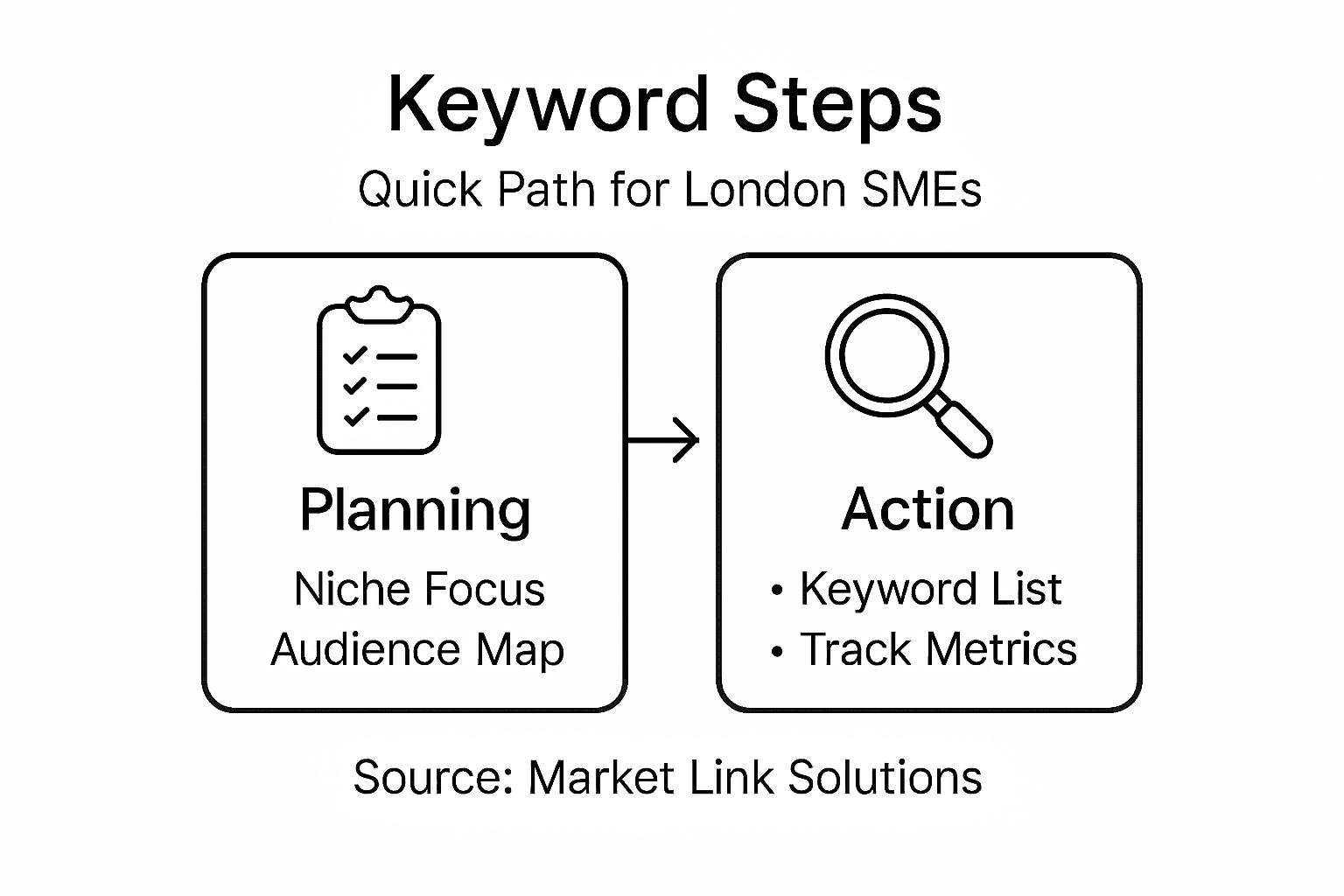
Monitoring keyword performance provides essential insights into your digital marketing efforts. Utilise strategic tracking tools that offer comprehensive analytics to help you understand your keyword rankings, search visibility, and potential areas for optimisation.
Key metrics to track for comprehensive keyword analysis:
- Search engine ranking positions
- Organic traffic volume
- Click-through rates
- Conversion rates
- Keyword difficulty
- Competitor keyword performance
Implement these systematic tracking approaches:
- Set up Google Search Console
- Use specialised SEO tracking tools
- Create monthly performance reports
- Compare against competitor keywords
Regular analysis allows you to identify trends, adjust your strategy, and focus on keywords that deliver the most significant results for your business.
To help optimise your keyword tracking, here’s a summary of key performance metrics and their purposes:
| Metric | What It Measures | Why It Matters |
|---|---|---|
| Organic Ranking | Position in search results | Indicates visibility |
| Click-Through Rate | % of users clicking links | Reveals engagement |
| Conversion Rate | Website actions completed | Shows marketing effectiveness |
| Competitor Position | Rival keyword rankings | Highlights market opportunities |
Consistent monitoring transforms keyword research from a one-time task into a dynamic, evolving strategy.
Pro tip: Schedule quarterly comprehensive keyword performance reviews, treating them as strategic planning sessions to recalibrate your SEO approach based on real-world data and emerging search trends.
Unlock Your London Business Potential with Expert Keyword Strategies
Struggling to pinpoint the right keywords that truly resonate with your London audience can hold back your small business growth. This guide highlights how understanding search intent and focusing on localised keywords are essential to cutting through the noise and connecting with customers who are ready to engage. If managing keyword research feels overwhelming or if your website is not driving the traffic you need, you are not alone.
At Market Link Solutions, we specialise in tailored digital marketing solutions designed specifically for London SMEs. From SEO optimisation to building engaging websites and running targeted PPC campaigns on Google and Instagram, we help you translate keyword insights into measurable results. Discover how our proven approach has helped other businesses like yours by exploring our Success Stories Archives – Digital Marketing Agency – Market Link Solutions.

Take control of your local search presence today by partnering with a dedicated team that understands London’s unique market challenges. Visit Market Link Solutions to learn more about our full range of services and start your journey towards higher visibility and sustained growth. Ready to see how your small business can thrive through strategic keyword integration? Contact us now and transform your SEO efforts into business success.
Frequently Asked Questions
How can I assess my target audience for keyword research?
Understanding your target audience involves creating detailed buyer personas that capture demographics, interests, and pain points. Conduct market research through surveys or customer interviews to gather insights that reflect their needs and search behaviours.
What are local keywords and why are they important for my London SME?
Local keywords include specific terms and phrases that reflect your geographical area, such as neighbourhood names and local slang. These keywords are crucial for optimising your visibility in local search results, helping attract customers in your immediate vicinity.
How do I choose the right keywords for my small business website?
Select keywords that are relevant to your services and align with user search intent. Focus on long-tail keywords that show higher conversion potential and lower competition, and aim to integrate these naturally into your website content.
What metrics should I track to monitor keyword performance?
Key metrics to track include search engine ranking positions, organic traffic volume, click-through rates, and conversion rates. Regularly analyse these metrics to identify trends and adjust your keyword strategy accordingly, ensuring continuous improvement over time.
How often should I review my keyword strategy?
You should schedule quarterly reviews of your keyword performance to assess the effectiveness of your strategy. This allows you to recalibrate your approach based on real data and emerging search trends, helping to maximise your online visibility.