
Nearly 80 percent of british small businesses miss out on valuable local customers because their ads do not target specific London audiences. For restaurant and aesthetic clinic owners, understanding pay per click advertising can make the difference between attracting local diners or staying invisible online. This guide explains exactly how PPC strategies empower you to control your budget, reach relevant London customers, and gain measurable results—giving you a competitive edge in the British market.
Table of Contents
- PPC Advertising Explained For London SMEs
- Types Of PPC: Google, Instagram And Beyond
- How PPC Drives Local Customer Engagement
- Costs, ROI And Budget Control In PPC
- Common PPC Pitfalls And Winning Strategies
Key Takeaways
| Point | Details |
|---|---|
| PPC Advertising Benefits | PPC advertising allows London SMEs to gain immediate online visibility and target local customers efficiently with control over budgets and real-time performance tracking. |
| Diverse PPC Platforms | Beyond Google Ads, platforms like Instagram, Facebook, and LinkedIn offer unique targeting capabilities tailored for different types of businesses. |
| Data-Driven Strategies | Tracking metrics such as click-through rates and conversion rates enables businesses to refine their PPC strategies for better return on investment. |
| Avoiding Common Mistakes | Implementing mobile-optimised ads and a focused keyword strategy helps prevent wasted spend and improves ad effectiveness. |
PPC Advertising Explained for London SMEs
Pay-per-click (PPC) advertising represents a strategic digital marketing approach enabling London small and medium enterprises (SMEs) to rapidly gain online visibility and attract targeted customers. Unlike traditional advertising methods, PPC allows businesses to place targeted advertisements on platforms like Google and Bing, paying only when potential customers actually click on their ads.
The fundamental mechanism of PPC involves businesses bidding on specific keywords relevant to their products or services. When potential customers search for these keywords, the advertiser’s ad appears prominently in search results. For London SMEs, this means an opportunity to precisely target local customers using PPC strategies with remarkable efficiency. Businesses can set specific geographic parameters, ensuring their advertisements reach only London-based customers interested in their offerings.
PPC campaigns offer several critical advantages for local businesses. They provide immediate visibility, allowing new or smaller enterprises to compete alongside established brands. Advertisers maintain complete control over budget, can track performance metrics in real-time, and adjust strategies instantly based on campaign results. Restaurants, aesthetic clinics, and professional services can leverage these tools to showcase their unique value propositions directly to potential local customers.
Pro tip: Start with a modest budget and carefully monitor your click-through rates and conversion metrics to refine your PPC strategy without significant financial risk.
Types of PPC: Google, Instagram and Beyond
Pay-per-click (PPC) advertising encompasses a diverse range of platforms, each offering unique advantages for London small businesses seeking targeted digital marketing solutions. While Google Ads remains the most prominent PPC channel, savvy marketers are increasingly exploring alternative platforms to diversify their advertising strategies and reach specific audience segments.
Google Ads continues to dominate the PPC landscape, providing unparalleled reach across search, display, and video networks. However, emerging PPC platforms offer sophisticated targeting options for businesses with niche marketing needs, including social media channels like Instagram, Facebook, LinkedIn, and emerging platforms like TikTok. Each platform presents distinct targeting capabilities, allowing London businesses to connect with precise demographic and interest-based audiences.

For local London SMEs, understanding platform-specific strengths is crucial. Instagram and Facebook are ideal for visually-oriented businesses like restaurants, beauty clinics, and retail shops, offering immersive ad formats and granular targeting. LinkedIn proves exceptional for B2B services, while Google Ads remains unmatched for immediate purchase intent and local search visibility. Microsoft’s Bing Ads can also provide cost-effective alternatives with potentially lower competition compared to Google’s primary platform.
Here’s a concise comparison of leading PPC platforms for London SMEs:
| Platform | Strengths | Ideal Business Types | Unique Targeting Feature |
|---|---|---|---|
| Google Ads | Broad reach, high purchase intent | All, especially service sectors | Local search targeting |
| Visually rich ads, younger audience | Restaurants, retailers, salons | Interest-based targeting | |
| Detailed demographic targeting | Local shops, clinics | Custom audience groups | |
| Professional network, B2B focus | Consultants, agencies | Job role targeting | |
| Bing Ads | Lower cost per click, less competition | Niche services, small retailers | Geographic targeting |
Pro tip: Experiment with multiple PPC platforms simultaneously, allocating smaller budgets to test performance and gradually scaling investments in channels demonstrating the highest return on advertising spend.
How PPC Drives Local Customer Engagement
Pay-per-click (PPC) advertising represents a powerful mechanism for London small businesses to create meaningful connections with local customers, transforming digital marketing from a broad-brush approach to a precision-targeted engagement strategy. By leveraging sophisticated targeting capabilities, businesses can reach potential customers at exactly the right moment of purchase intent.
Local PPC strategies enable businesses to pinpoint customer engagement with unprecedented accuracy, utilizing geographic, demographic, and behavioural targeting features. For instance, a Shoreditch restaurant can display ads to hungry professionals within a specific postcode during lunch hours, or a Fulham aesthetic clinic can target individuals searching for beauty treatments within a 5-mile radius. This hyper-localised approach ensures marketing budgets are spent efficiently, reaching only the most relevant potential customers.
The real magic of PPC lies in its ability to create immediate, measurable interactions. Unlike traditional advertising, PPC platforms provide real-time analytics that show exactly how many people saw the ad, clicked through, and potentially converted into paying customers. Local businesses can track metrics like click-through rates, conversion percentages, and cost per acquisition, allowing for continuous refinement of marketing strategies. This data-driven approach transforms advertising from a speculative expense into a strategic investment with clear, quantifiable returns.
Pro tip: Implement location-based ad extensions in your PPC campaigns to showcase your business address, contact details, and operating hours, making it easier for local customers to connect with you instantly.
Costs, ROI and Budget Control in PPC
Pay-per-click (PPC) advertising offers London small businesses an unprecedented level of financial flexibility and transparency in their marketing investments. Unlike traditional advertising methods with fixed costs and uncertain outcomes, PPC provides granular budget control, allowing businesses to start with modest investments and scale strategically based on measurable performance.
UK-based PPC campaigns present nuanced cost management opportunities that empower small businesses to maximise their marketing budgets. Average click costs can range from £0.50 to £5 depending on industry competitiveness, with businesses maintaining complete control over daily and total campaign expenditure. This means a restaurant in Soho or an aesthetic clinic in Kensington can set precise spending limits, ensuring no unexpected marketing expenses disrupt their financial planning.
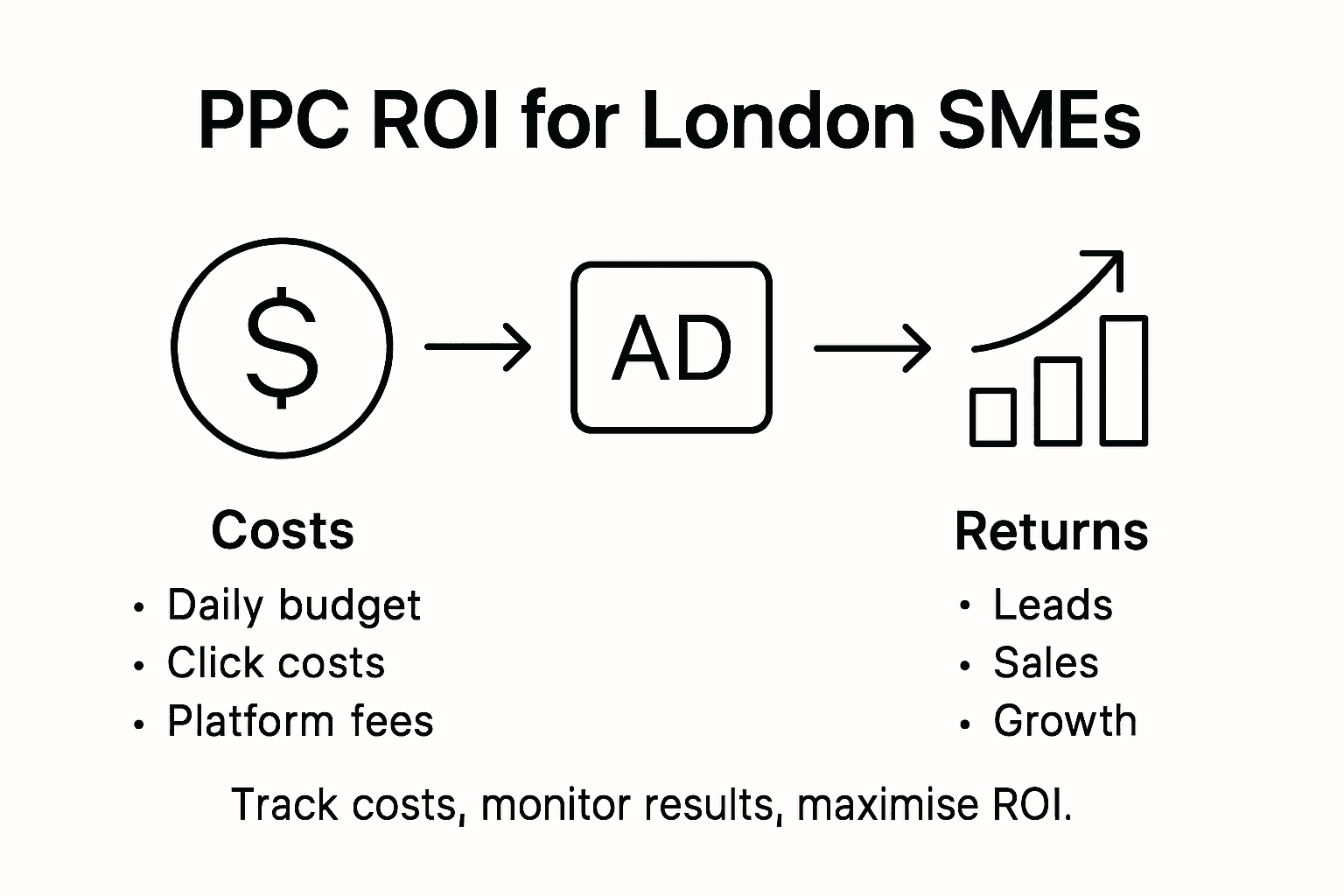
Calculating return on investment (ROI) in PPC is remarkably straightforward, thanks to advanced tracking technologies. Businesses can directly attribute conversions—whether phone calls, bookings, or online purchases—to specific ad campaigns. By analysing metrics like cost per acquisition, conversion rates, and total revenue generated, London SMEs can make data-driven decisions about scaling or adjusting their digital marketing strategies. This transparent approach transforms advertising from a speculative expense into a predictable, measurable business growth tool.
This summary shows key PPC performance metrics London SMEs should monitor:
| Metric | What It Measures | Business Impact |
|---|---|---|
| Click-through Rate | Ad engagement percentage | Reveals ad relevance |
| Conversion Rate | Actions following a click | Shows marketing effectiveness |
| Cost Per Acquisition | Expense per new customer gained | Assesses financial efficiency |
| Return on Investment | Profit from PPC spend | Aids strategic decision-making |
Pro tip: Start with a conservative daily budget, allocate funds across multiple platforms, and continuously monitor performance metrics to incrementally optimise your PPC spending.
Common PPC Pitfalls and Winning Strategies
Navigating the complex landscape of pay-per-click (PPC) advertising requires strategic insight and a nuanced understanding of potential challenges. Small businesses in London must be aware of common missteps that can drain marketing budgets and undermine campaign effectiveness, transforming potential opportunities into costly learning experiences.
Digital marketing experts highlight critical PPC mistakes businesses must proactively avoid, with mobile optimisation emerging as a paramount consideration. Many London SMEs mistakenly create desktop-centric ads that fail to render effectively on smartphones, where over 60% of local searches now originate. Successful campaigns demand responsive design, fast-loading landing pages, and mobile-friendly ad formats that seamlessly adapt to varying screen sizes and user interactions.
Keyword strategy represents another crucial battleground where businesses frequently stumble. Inexperienced marketers often cast overly broad nets, targeting generic terms that generate expensive, low-quality traffic. The winning approach involves developing granular, highly specific keyword clusters that match precise customer intent. For a Shoreditch aesthetic clinic, this might mean targeting ‘professional skin rejuvenation in East London’ rather than the generic ‘beauty treatments’, thereby attracting more qualified potential clients while maintaining more economical click costs.
Pro tip: Implement a robust negative keyword strategy to filter out irrelevant searches and prevent wasted ad spend, continuously refining your targeting based on actual search term reports.
Unlock the Full Potential of PPC for Your London Business
Struggling to achieve precise local reach and maximise your marketing budget Does navigating PPC advertising feel overwhelming We understand the challenges London SMEs face when trying to compete within crowded digital spaces — from managing budgets to targeting the right customers at the right time. This article highlights key pain points like controlling costs while driving real customer engagement and refining campaigns based on performance data.
At Market Link Solutions we specialise in helping small London businesses overcome these exact hurdles. Whether you need expert PPC Advertising on Google and Instagram or support with web design and development and SEO optimisation, our tailored solutions empower you to build highly targeted campaigns that convert. Discover how we have transformed local marketing for others by browsing our inspiring Success Stories Archives.
Take control of your PPC strategy today with proven experts who understand London’s unique market pressures. Visit Market Link Solutions now and let’s turn your digital advertising into measurable growth.
Frequently Asked Questions
What is PPC advertising and how does it work?
Pay-per-click (PPC) advertising is a digital marketing method where businesses pay for ads that appear in search engine results or on social media platforms, only paying when a user clicks on their ad. Advertisers bid on keywords, and their ads are shown based on this bidding and relevance to the search query.
What are the main advantages of PPC for small businesses?
PPC provides small businesses with immediate visibility, precise targeting capabilities, and full budget control. It allows them to compete with larger brands, track campaign performance in real-time, and adjust strategies for optimal results based on measurable metrics.
How can London SMEs effectively target local customers through PPC?
Local SMEs can leverage PPC advertising by setting geographic targeting to ensure their ads reach customers in specific areas, using keywords associated with local intent, and utilising location-based ad extensions to provide relevant information like contact details and operating hours.
What common mistakes should London SMEs avoid in their PPC campaigns?
Common mistakes include failing to optimise ads for mobile devices, targeting overly broad keywords, and not implementing a negative keyword strategy to filter out irrelevant searches. Addressing these areas can help optimise campaigns and reduce wasted ad spend.