
More than 60 percent of British small businesses now invest in digital marketing, but many still overlook the game-changing impact of pay-per-click advertising. Navigating a crowded online space can be tough for any London entrepreneur, especially when traditional tactics fall flat. This guide reveals how PPC advertising helps British business owners attract local customers, manage budget with accuracy, and see immediate results that drive real growth.
Table of Contents
- Defining PPC Advertising for Small Businesses
- Key Types of PPC Platforms Explained
- How PPC Campaigns Drive Local Results
- Comparing PPC Ads to Other Marketing Methods
- Common PPC Mistakes London Businesses Make
Key Takeaways
| Point | Details |
|---|---|
| Understanding PPC | PPC advertising allows small businesses to pay for clicks on targeted ads, enhancing visibility and customer acquisition compared to organic methods. |
| Effective Platform Use | Leveraging diverse PPC platforms, such as Google Ads and social media, allows for precise targeting and increased engagement with specific audiences. |
| Local Targeting Importance | Local PPC strategies enable businesses to focus their efforts on specific geographic areas, maximising relevance and return on investment. |
| Avoiding Common Mistakes | Strategic keyword targeting and continuous campaign management are crucial to avoid wasted expenditure and improve conversion rates. |
Defining PPC Advertising for Small Businesses
Pay-per-click (PPC) advertising represents a strategic digital marketing approach where businesses pay a fee each time someone clicks on their online advertisement. Pay-per-click advertising enables small businesses to purchase targeted website visits rather than attempting to earn those visits organically through search engine optimisation.
At its core, PPC advertising works like an auction-based digital marketplace. Businesses bid on specific keywords relevant to their target audience, creating advertisements that appear in search engine results or on partner websites. When a potential customer clicks the advertisement, the business pays a small fee. This model allows London-based small businesses to control their marketing budget precisely while reaching customers actively searching for their products or services.

The fundamental mechanics of PPC advertising involve several key components. Businesses select targeted keywords, craft compelling advertisement copy, and set a maximum budget for their campaigns. PPC advertising strategies typically include platforms like Google Ads, which display advertisements across search results and partner networks. For small businesses in competitive markets like London, PPC provides an agile method to increase visibility, attract potential customers, and generate immediate website traffic.
Successful PPC campaigns require strategic planning and ongoing management. Small business owners must continuously monitor their advertisement performance, adjust keyword targeting, and optimise their landing pages to improve conversion rates. By understanding these intricate details, London entrepreneurs can leverage PPC advertising as a powerful tool for digital growth and customer acquisition.
Key Types of PPC Platforms Explained
PPC advertising encompasses multiple digital platforms that enable small businesses to reach potential customers through targeted online advertisements. Key PPC platforms provide diverse opportunities for London businesses to connect with their audience across different digital channels, each offering unique advantages and targeting capabilities.
Google Ads remains the most prominent PPC platform, allowing businesses to display advertisements directly within search results and across Google’s extensive partner network. These advertisements appear seamlessly alongside organic search results, enabling businesses to capture immediate customer attention. Complementing Google Ads, Microsoft Advertising (formerly Bing Ads) offers an alternative search engine platform that can access different audience segments, particularly beneficial for businesses targeting professional or enterprise customers.
Social media platforms have emerged as powerful PPC advertising channels. Instagram and Facebook Ads provide sophisticated demographic and interest-based targeting, allowing London small businesses to reach highly specific audience segments. These platforms enable precise audience segmentation based on age, location, interests, and behavioural patterns, making them exceptionally effective for businesses with well-defined target markets.
Emerging platforms like TikTok Ads and Pinterest Ads are expanding the PPC landscape, offering innovative ways to connect with younger and more visually-oriented audiences. Each platform presents unique strengths: TikTok excels in engaging younger demographics through short-form video content, while Pinterest provides exceptional opportunities for businesses in creative, lifestyle, and visual industries. Small businesses can strategically diversify their advertising approach by understanding and leveraging these different PPC platforms to maximise their digital marketing reach.
How PPC Campaigns Drive Local Results
Local PPC advertising transforms digital marketing for small businesses by enabling hyper-targeted communication with potential customers in specific geographic areas. Targeting specific audiences based on location ensures that advertisements reach precisely the right demographic, maximising marketing efficiency and return on investment for London-based enterprises.
Geographic targeting represents a powerful mechanism in PPC campaigns, allowing businesses to refine their advertising reach. Entrepreneurs can configure their advertisements to appear only to users within specific London postcodes, neighbourhoods, or radiuses around their physical business location. This precision means a local café in Shoreditch can attract nearby customers, or a professional services firm in the City of London can target corporate professionals within walking distance.
Local PPC strategies offer granular control over advertising budgets and audience engagement. Businesses can adjust their targeting parameters to include factors like time of day, device type, and user interests, creating a sophisticated approach to digital marketing. For instance, a personal trainer in Hackney might schedule advertisements during early morning and evening hours, targeting mobile users searching for fitness services in their immediate area.
The true power of local PPC campaigns lies in their ability to bridge digital advertising with real-world business objectives. By leveraging location-based targeting, demographic insights, and precise audience segmentation, London small businesses can transform online interactions into tangible foot traffic, phone calls, and direct sales inquiries. This approach turns digital advertising from a broad marketing tool into a strategic, results-driven business growth mechanism.
Comparing PPC Ads to Other Marketing Methods
Digital marketing strategies have evolved dramatically, with PPC advertising emerging as a powerful alternative to traditional marketing approaches. PPC offers trackable, targeted, and cost-effective advertising that provides measurable returns on investment, distinguishing itself from conventional marketing methods that often rely on broad, less quantifiable techniques.
Unlike traditional print or broadcast advertising, where businesses invest significant budgets without guaranteed results, PPC allows for precise budget control and immediate performance tracking. A small London restaurant can spend £10 on digital advertisements and receive detailed insights about impressions, clicks, and conversions, whereas a newspaper advertisement offers minimal data beyond circulation numbers. Online advertising strategies enable businesses to adjust campaigns in real-time, optimising spending and targeting based on actual performance metrics.
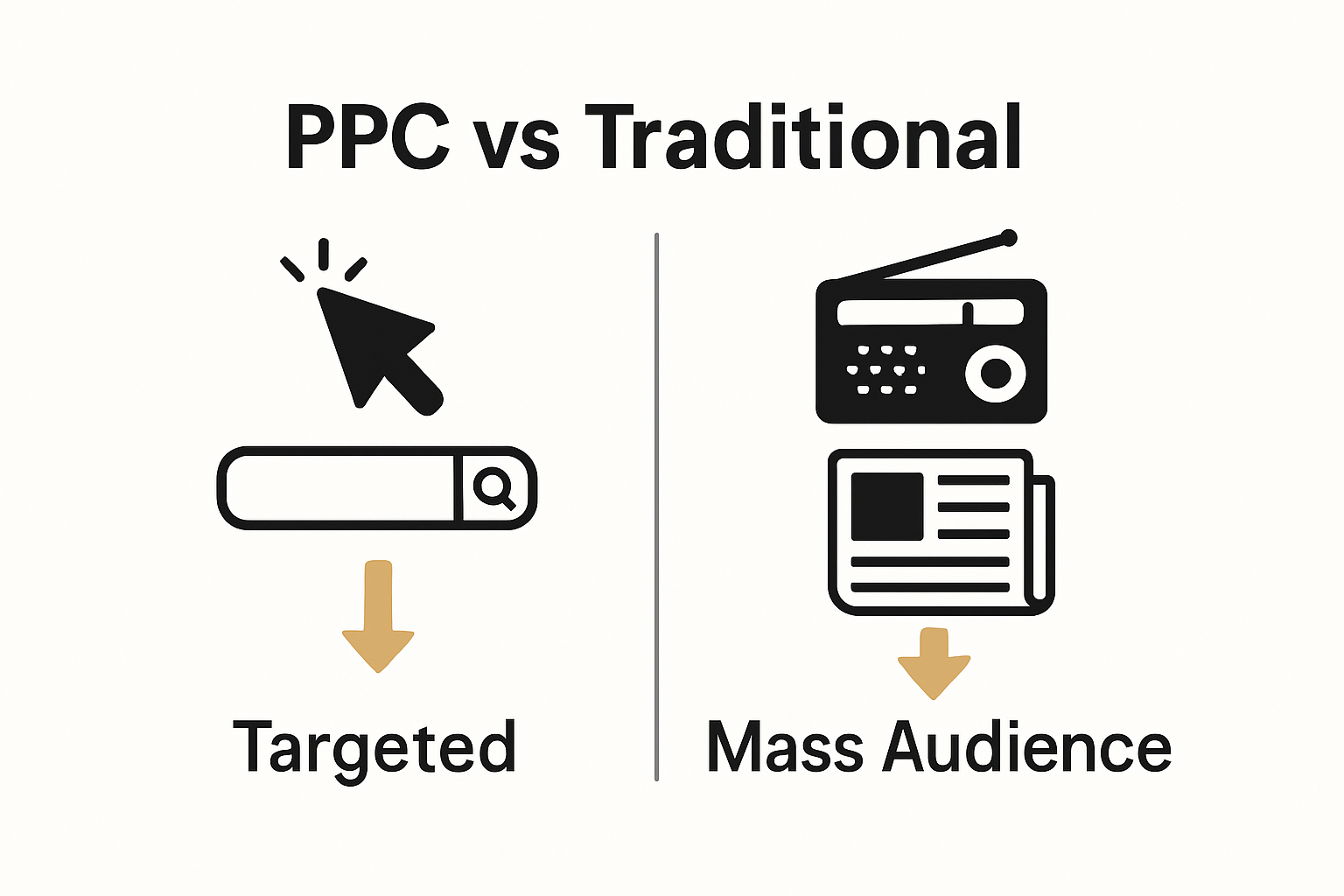
Traditional marketing channels like billboards, radio spots, and print media operate on a scattergun approach, broadcasting messages to broad audiences with limited targeting capabilities. PPC advertising, by contrast, provides granular audience segmentation. Businesses can target specific demographics, interests, locations, and even behaviours, ensuring that every pound spent reaches potential customers most likely to convert. This precision dramatically improves marketing efficiency, allowing small businesses to compete effectively against larger competitors with more extensive marketing budgets.
The fundamental difference lies in accountability and adaptability. While traditional marketing methods require substantial upfront investments with uncertain outcomes, PPC advertising offers a transparent, data-driven approach. London small businesses can experiment, measure, and refine their marketing strategies quickly, transforming digital advertising from a cost centre into a predictable, scalable growth engine. The ability to track every interaction, understand customer behaviour, and adjust strategies in real-time makes PPC an increasingly attractive option for businesses seeking measurable marketing results.
Common PPC Mistakes London Businesses Make
PPC advertising requires strategic execution, and many London small businesses inadvertently sabotage their own campaigns through common operational errors. Google Ads strategies demand precision and careful planning to avoid costly missteps that can drain marketing budgets without delivering meaningful results.
One fundamental mistake involves imprecise keyword targeting. Small businesses often select overly broad keywords that attract irrelevant traffic, burning through their advertising budget without generating quality leads. A personal trainer in Camden might mistakenly bid on generic terms like “fitness” instead of targeted phrases such as “personal training Camden” or “fitness classes North London”, resulting in wasted expenditure and low conversion rates.
Another critical error is neglecting ongoing campaign management and performance analysis. PPC advertising is not a set-it-and-forget-it strategy. Successful campaigns require continuous refinement, including regular keyword adjustments, ad copy optimisation, and systematic performance tracking. Restaurant PPC advertising demands particularly nuanced approaches, with restaurateurs needing to adapt their targeting based on seasonality, local events, and evolving customer preferences.
The final significant pitfall involves inadequate landing page design and conversion infrastructure. Many London businesses create PPC advertisements without developing corresponding landing pages that effectively capture and convert interested prospects. A well-designed landing page should feature clear value propositions, compelling calls to action, mobile responsiveness, and streamlined user experience. Businesses that treat their landing pages as afterthoughts frequently discover that their advertising investment generates clicks but fails to transform those interactions into tangible business outcomes.
Unlock the Full Potential of PPC Advertising for Your London Business
Small businesses in London face unique challenges with PPC advertising such as targeting the right keywords, managing campaigns constantly and creating landing pages that convert effectively. These common pitfalls can waste your budget and limit your customer growth. If you want precise audience targeting, real-time optimisation and measurable returns, then a tailored PPC strategy is essential for your business success.
Discover how our London-based digital marketing agency helps small businesses like yours overcome these exact issues. Explore proven tactics and real client results in our Success Stories Archives – Digital Marketing Agency – Market Link Solutions.
Ready to transform your PPC campaigns into a powerful growth engine Stay ahead in London’s competitive market by partnering with experts who deliver targeted Google and Instagram advertising, along with SEO and website solutions. Visit Market Link today and start turning clicks into customers.
Frequently Asked Questions
What is PPC advertising and how does it work?
PPC advertising, or pay-per-click advertising, is a digital marketing model where businesses pay a fee each time their advertisement is clicked. Businesses bid on specific keywords to display their ads in search results or partner websites, allowing them to attract targeted traffic and reach potential customers actively searching for their products or services.
What are the main platforms for PPC advertising?
The primary platforms for PPC advertising include Google Ads, Microsoft Advertising, and social media channels like Facebook, Instagram, TikTok, and Pinterest. Each platform offers unique targeting capabilities and audience engagement opportunities, enabling businesses to tailor their campaigns according to their specific marketing goals.
How can local PPC advertising benefit my business?
Local PPC advertising allows businesses to target specific geographic areas, ensuring advertisements reach potential customers in close proximity to their location. This targeted approach maximises marketing efficiency and can drive foot traffic, phone calls, and conversions by connecting with local audiences looking for services nearby.
What common mistakes should I avoid in my PPC campaigns?
Common mistakes in PPC campaigns include using overly broad keywords that attract irrelevant traffic, neglecting ongoing campaign management, and having poorly designed landing pages. To avoid wasting budget and improve conversion rates, focus on precise keyword targeting, regular performance analysis, and creating effective landing pages that convert clicks into customer interactions.
Recommended
- 7 Key Advantages of PPC Ads for London Small Businesses
- The Essential Guide to PPC Advertising UK
- SEO vs PPC Explained: Choosing the Right Strategy
- Restaurant PPC Advertising Guide for London Success – Digital Marketing Agency – Market Link Solutions
- Unveiling London’s Perfume Culture: Your Scent Shopping Guide
- Corporate Tax Planning Explained: UK Business Essentials